We use cookies to optimise our website functionality and give you the best experience possible. Please, accept our Terms and Conditions. ACCEPT
IN THE TIME OF KOCHI-MUZIRIS BIENNALE (KMB) 2025-26
INDIA IN STYLE: DAY 01-25
India in Style, created as part of Ayurveda Trails & Journals, does not want to be anything else but an artistic expression of a healthy lifestyle inspired by ancient healing traditions, creating harmony with the dynamics of contemporary life. During the Kochi-Muziris Biennale 2025-26, our founder Zuzana Zwiebel introduces one artist, event, or organisation every day, which can inspire all of us. Enjoy the journey!
We move away from the idea of the Biennale as a singular, central exhibition-event, and instead envision it as a living ecosystem; one where each element shares space, time, and resources, and grows in dialogue with each other. In Kochi, a historic port city where trade once connected distant worlds, we begin with our site and region to engage in dialogue with emerging global perspectives. This rootedness allows us to resist the pressures of the conventional biennale model as a finished spectacle, and instead shape something that is evolving, responsive, and alive. Read more >>
KOCHI-MUZIRIS BIENNALE
The sixth edition of the Kochi-Muziris Biennale is an invitation to embrace process as methodology, and to place the friendship economies that have long nurtured artist-led initiatives as the very scaffolding of the exhibition.
KOCHI-MUZIRIS BIENNALE 2025-26
FACEBOOK >>
INSTAGRAM >>
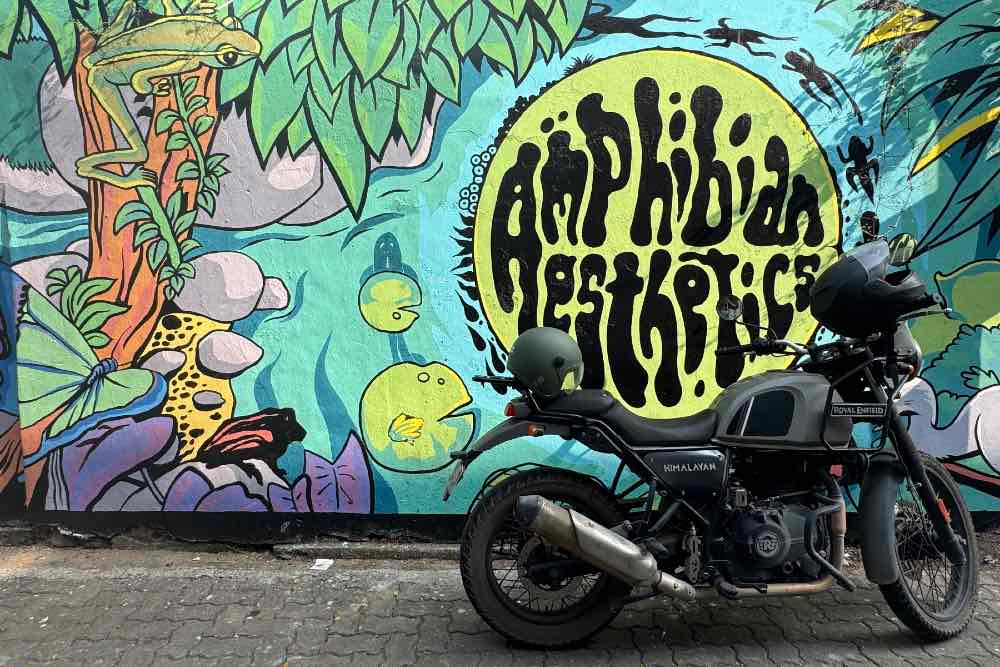
In a moment when the Anthropocene’s crises feel less like warnings and more like our everyday weather, Ishara House opens its doors in Kochi’s historic Kashi Hallegua House; a site shaped by centuries of migration, refuge, and maritime confluence. The exhibition ‘Amphibian Aesthetics’ asks what it means to think, feel, and imagine in a world built on precarity, fluidity, and entangled histories.
Conceived under the artistic direction of Riyas Komu, the Ishara House emerges as a dynamic space for contemporary art, research, and exchange - one attentive to the urgencies of our time, yet rooted in the lived textures of Kerala’s oceanic pasts. Presented by Aazhi Archives with curatorial advisors CS Venkiteswaran, M.H. Ilias, and Amrith Lal, the exhibition brings together 12 artists and collectives across India, Italy, Palestine, and the UAE. Their works mine the amphibian as metaphor and method: a double life negotiated between land and sea, memory and displacement, body and world. Read more >>
ISHARA ART FOUNDATION, AAZHI ARCHIVES, URU ART HARBOUR
Across installations, performances, talks and conversations at Kashi Hallegua House and Uru Art Harbour, the works chart the residual currents that shape our collective imaginaries, maritime trade routes, exilic journeys, ecological disruptions, and the intricate hydrosocial webs that bind life across species. In doing so, the exhibition will offer not just art objects, but propositions for thinking with porousness, with instability, and with the fragile ecologies we inhabit. .
AMPHIBIAN AESTHETICS >>
ISHARA ART FOUNDATION >>
AAZHI ARCHIVE >>
URU ART HARBOUR >>
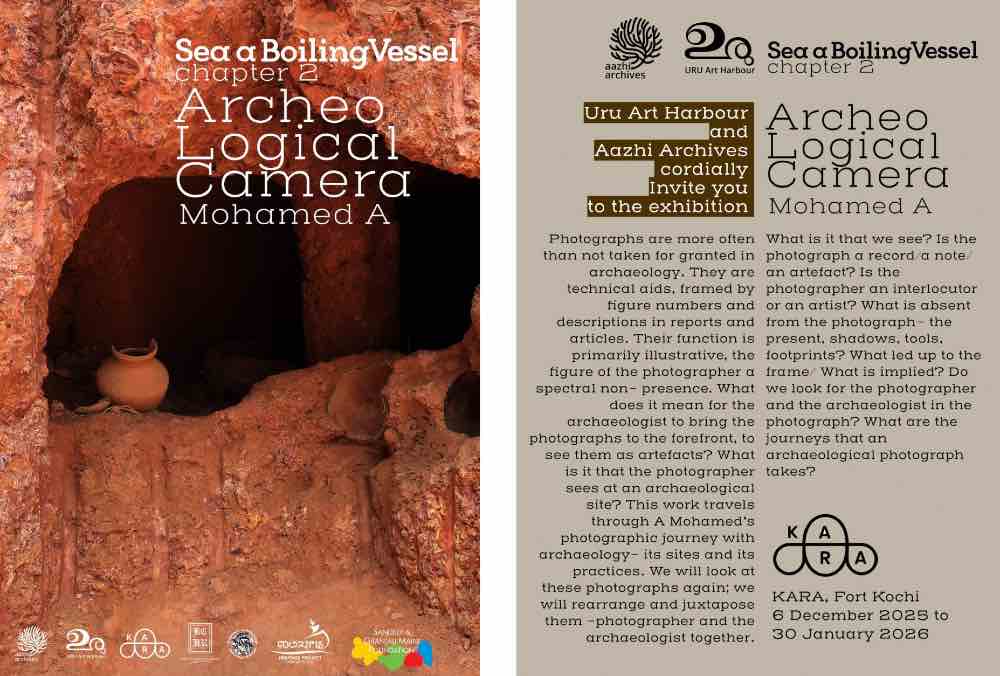
Can pre-historic artifacts be art? Come see for yourself at Kara, as we walk through artist Mohamed A’s photographic journey with archaeology, its sites and its practices.
A Mohamed’s photographic images of excavations and the excavated - real, yet mysterious and enigmatic - take us on a journey into Kerala’s prehistoric past. It is the story of how we came to be what we are, told through the archeological sites, architectures, implements and artefacts. They bring into vision sediments and remnants of the great voyages of yore, and also human engagements with life and imaginations about after-life. Read more >>
ARCHEO LOGICAL CAMERA BY MOHAMED A
Kara Gallery, Ridsdale Road on Parade Ground, Fort Kochi
From 6 December 2025 to 30 January 2026
Show in collaboration with Aazhi Archives, URU Art Harbour, Department of Archaeology (Government of Kerala), Sandeep & Gitanjali Maini Foundation, and Muziris Heritage Project.
ARCHEO LOGICAL CAMERA BY MOHAMED A >>
AAZHI ARCHIVE >>
URU ART HARBOUR >>
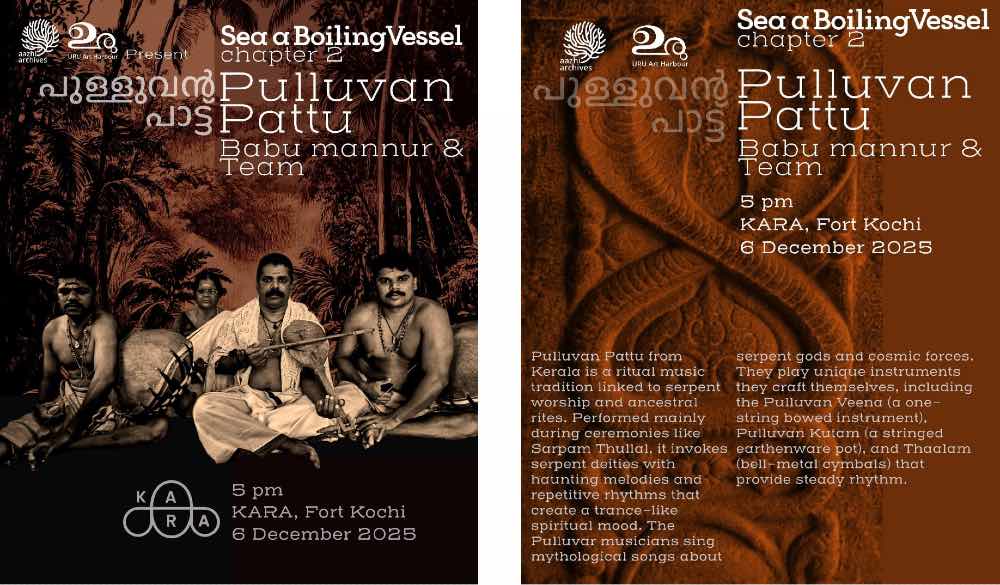
A mesmerizing Pulluvan Pattu performance led by Babu Mannur was introduced to the audience during the opening evening of the Archaeological Camera by Mohammed A. Pulluvan Pattu is a ritualistic form of serpent worship. Explore the beauty of this sacred folk music and art tradition from Kerala in the links below.
PULLAVAN PATTU, A PERFORMANCE BY BABU MANNUR & TEAM DURING THE OPENING EVENING OF THE ARCHEO LOGICAL CAMERA BY MOHAMED A
ARCHEO LOGICAL CAMERA BY MOHAMED A - ARTICLE >>
ARCHEO LOGICAL CAMERA BY MOHAMED A - VIDEO OPENING EVENING >>
AAZHI ARCHIVE >>
URU ART HARBOUR >>
KERALA TOURISM - SARPAM THULLAL - SERPENT DANCE >>
KR SUNIL
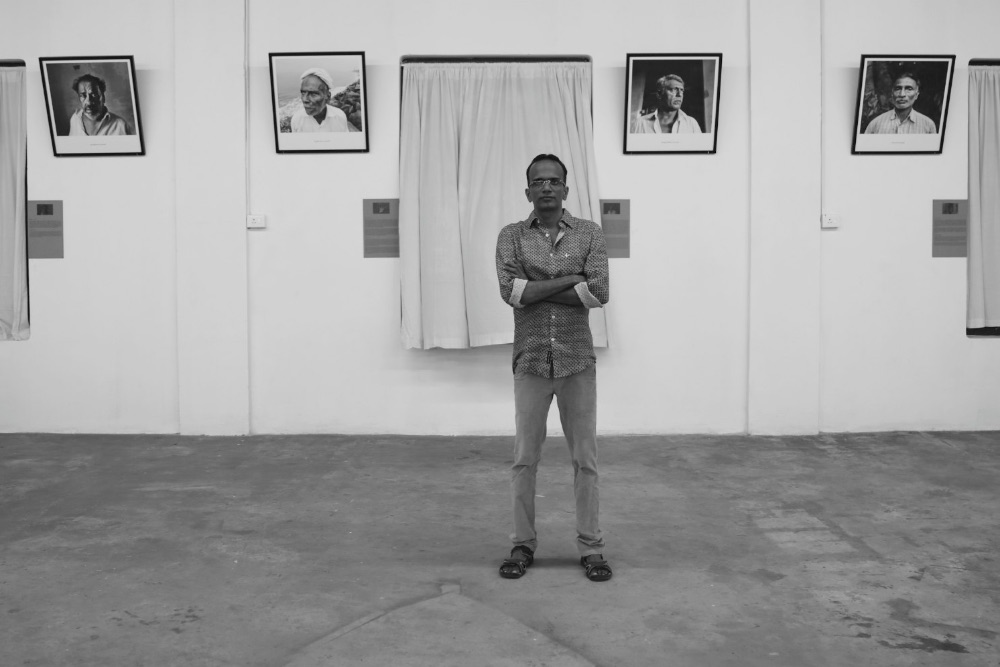
KR Sunil was born in Kodungallur in 1975. After receiving his national diploma in sculpture from Fine Arts College, Thrissur, he started actively pursuing art, writing and photography. Sunil picks out extraordinary personalities in the course of his study of the daily lives of common people and presents them in photo features in contemporary media. What marks Sunil’s art exceptional is his involvement in the sustained process of observation and documentation of the people he has come to notice. Environmentally sensitive spaces are another area that becomes the focus of his photographic projects. KR Sunil was one of the Aazhi Archives featured photographers during the International Spice Route Conference 2026. Some of his earlier work can be found on our website.
KR SUNIL >>
KR SUNIL: MANCHUKKAR - THE SEAFARERS OF MALABAR >>
FACEBOOK >>
INSTAGRAM >>
BIJU IBRAHIM
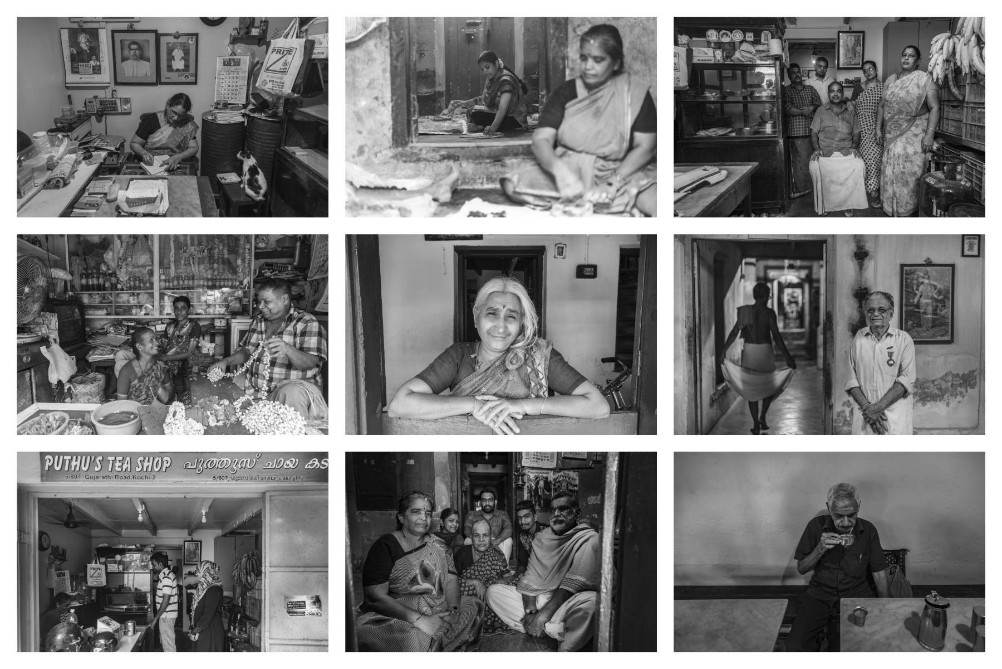
Biju Ibrahim's photographic practice involves eight years of rigorous practice in making images, having received no formal education and training in photography — with the weight of the labour, journeys across fractured landscapes, burnt down histories, Biju Ibrahim captures the essence of rustic geographies, the people who are now becoming archive of the earth, the mythic and mystery of spaces and places, broken vessels and torn fabric, alleys of now filled with the density of then or before.  He is passionate about capturing the histories and existential praxis of the mystic cultures of Kondotty and Ponnani, the two coastal geographies of Malabar and their linkages with the faraway lands of Arab and the Greek region embedded in the mark of coevalness and multiplicities, of vanishing textures and grains of languages and history’s voice. Biju Ibrahim was one of the Aazhi Archives featured photographers during the International Spice Route Conference 2026. Some of his earlier work can be found on our website.
COMMUNITIES OF KOCHI BY BIJU IBRAHIM >>
FACEBOOK >>
INSTAGRAM >>
RAKESH ANAND
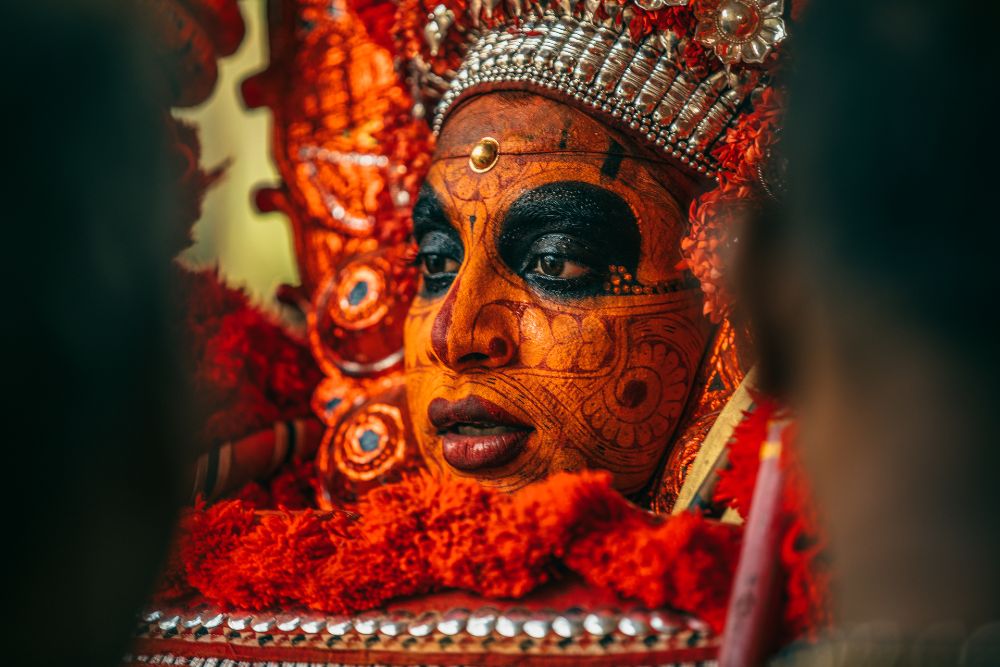
As the Theyyam season approaches, we are featuring one of the Aazhi Archives photographers, Anand Rakesh, and his pictures documenting this ancient tradition. Theyyam is a vibrant and colorful form of ritualistic worship that is deeply rooted in the culture and traditions of Kerala, India. This living tradition involves elaborate rituals, music, dance, and vibrant costumes that bring to life the divine spirits being invoked. Each Theyyam performance is unique, featuring different deities, stories, and rituals. The performers, who are typically men from specific communities, undergo rigorous training and preparation before they are allowed to participate in the ritual.
THEYYAM: RED GODS BY RAKASH ANAND >>
WEBSITE >>
INSTAGRAM >>
SHANKA TRIBE
Hailing from Kerala, Shanka Tribe is a tribal music band which resonates the inner turbulence of our ancestors and their amazing cultural heritage, which awakens the soul of the listener into seeking the higher cause of their existence. Shanka Tribe derives its inspiration from various styles and genres of music. We try to incorporate human emotions experimentally with chants, sounds and expressions. We also try to melodically amalgamate them with various instruments not normally used, especially the tribal instruments. The result is a music that has no lyrics, but still conveys a deep emotion within. We always begin our performance by blowing the Shankh, which purifies our soul and surroundings.
WEBSITE >>
YOUTUBE >>
INSTAGRAM >>
SHAHABAZ AMAN
Shahabaz Aman (born 27 December 1969) is an Indian singer and composer. He was born in Malappuram, Kerala, India. He is also a stage performer of Ghazal music. Shahabaz is known for his soulful, romantic voice and unique style of singing. He has released music albums of various genres and performed across India and Persian Gulf countries. He is a two-time winner of Kerala State Film Award for Best Singer.
YOUTUBE >>
FACEBOOK >>
INSTAGRAM >>
RESMI SATEESH
Resmi Sateesh is an Indian singer and actor from Kerala predominantly known for her songs in the Malayalam films.She has also acted in the movie 22 Female Kottayam and worked as location sound recordist for the movie Makaramanju directed by Lenin Rajendran.Born in Parassala, Reshmi studied classical music from the age of six under the tutelage of Muthiah Bhagavathar from Tamil Nadu after her music studies under Alleppey Sreekumar. She has also studied "Audiography" at the Satyajit Ray Film & Television Institute in Calcutta. She holds B.Sc. in physics masters in Social Work from the University of Calicut. She is also known for her stage performance and has performed at several international events including Kochi-Muziris Biennale, Aazhi Archives and Uru Art Harbour.
YOUTUBE >>
FACEBOOK >>
INSTAGRAM >>
KIRTIKA KAIN
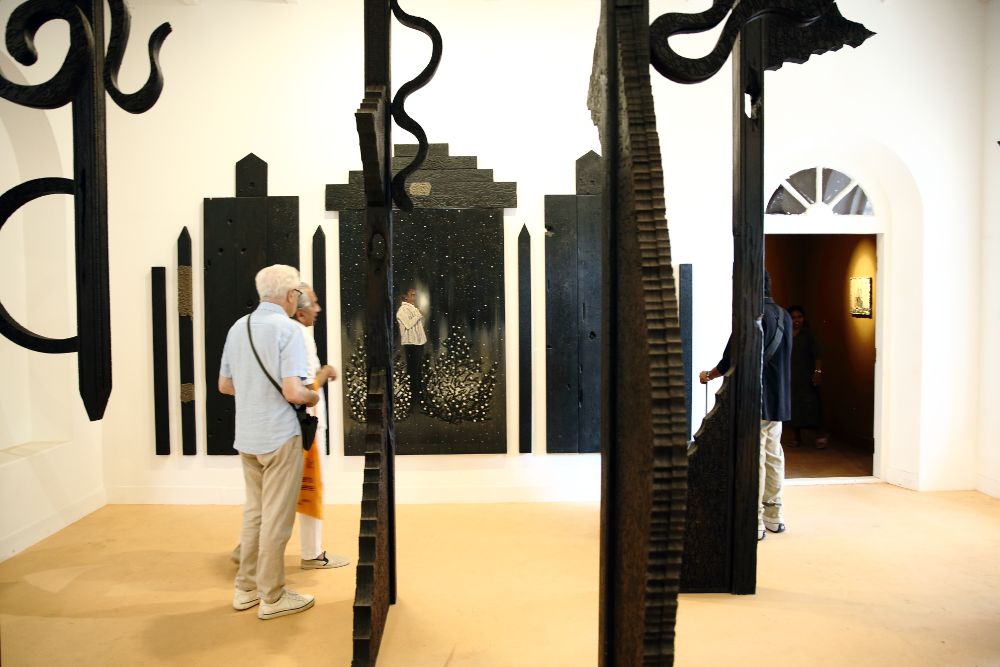
Based in Sydney, on Dharug land, artist Kirtika Kain applies experimental printmaking processes to materials that have been used for thousands of years in ritual and ceremony, such as tar, copper, gold, and cotton. Kain is attentive to the histories of labour and social relations that each of these ancient materials has witnessed and absorbed. Her process includes a dialogue between her body and the material, drawing out the distinctive qualities and limitations of each to think through complex questions of history, memory, and the inheritance of the Dalit diaspora. At the Kochi-Muziris Biennale, Kain presents works in tar and gold leaf, as well as a series of suspended copper plates that punctuate the viewing space. (Aparna Chivukula)
WEBSITE >>
ARTIST TALK >>
INSTAGRAM >>
DHIRAJ RABHA
At the Kochi-Muziris Biennale, Dhiraj presents The Quiet Weight of Shadows (2025), part documentary, part surreal reflection on the power dynamics between state and community, dissonance between lived experiences and official accounts and the fractures between generations marked by post-traumatic stress and hyper-vigilance. A disconcerting garden of carnivorous flowers with sharp white teeth grows incandescent under blue UV light, buzzing with news reports on the ULFA movement in Assamese. (Aparna Chivukula)
DHIRAJ RABHA'S WORK CASTS LONG SHADOWS OF INSURGENCY >>
FACEBOOK >>
INSTAGRAM >>
RB SHAJITH
RB Shojith's subliminal paintings of the Malabar region's rural landscapes bear subtle yet acute specificities that transcend realism. Drawing on memories and sensory impressions of the terrain he grew up in, his practice expresses an aesthetic resistance to the homogenising forces that subsume microcultures and functions as a memorial to the landscapes erased by climate change.. (Aswathy Gopalakrishnan)
FACEBOOK >>
INSTAGRAM >>
SHEBA CHHACHHI & JANET PRICE
Narrated in the first person by Janet Price, the three- channel video installation, Beauty/Pain (2025) presents an embodied account, charting the debilitations and potential possibilities that emerge in states of chronic distress; a biography of pain. Against a symptomatic reading of pain as signalling bodily waywardness or error, Chhachhi and Price orient us to view chronic pain as a compass towards the trans/formations underway in our inner worlds and as an unruly friend that can both estrange us from the world or submerge us in its shared precarities. The film interjects Price's conversations with medical professionals, anchored by vivid visualisations of neural networks in her brain through medical imaging technologies, with a choral recounting of the displacement of holistic and humoral traditions, herbal life-worlds, and therapeutic methodologies rooted in principles of balance, nurture, and healing by modern medicine. (Arushi Vats)
BEAUTY / PAIN >>
MARINA ABRAMOVIC
Born and raised in post-war Yugoslavia, Marina Abramovic's prolific, radical body of work that spans five decades continues to shape the field of performance art. Process becomes sculptural in her works, drawing spectatorial attention to its time and materiality, and its political, moral, and ethical dimensions, unravelling the complex relationship between artist and spectator. In her performances, choreographed movement is often replaced with ritualistic repetition and stillness, where transformation and transcendence through acts of endurance challenge a conventional aesthetic experience, while conjuring an uncanny space of introspection and catharsis..
MARINA ABRAMOVIC INSTITUTE – MAI >>
MARINA ABRAMOVIC INSTITUTE - MAI
Marina Abramovic Institute (MAI) presents and supports performance art at a global scale. Through an artist-driven process, the Institute maintains both a multidisciplinary approach to performance and a focus on long, durational work. Fostering an international network of performance artists and public participants, MAI is a part of the legacy of Marina Abramovic. Founded eponymously in 2012, MAI is dedicated to furthering the artist's commitment to time-based and immaterial art, spanning dance, theatre, film, video, opera, music, and other emergent forms of performance. The Institute connects practice with pedagogy and research by hosting workshops, public lectures, residencies, and discussions.
MARINA ABRAMOVIC INSTITUTE – MAI >>
FAIZA HASAN
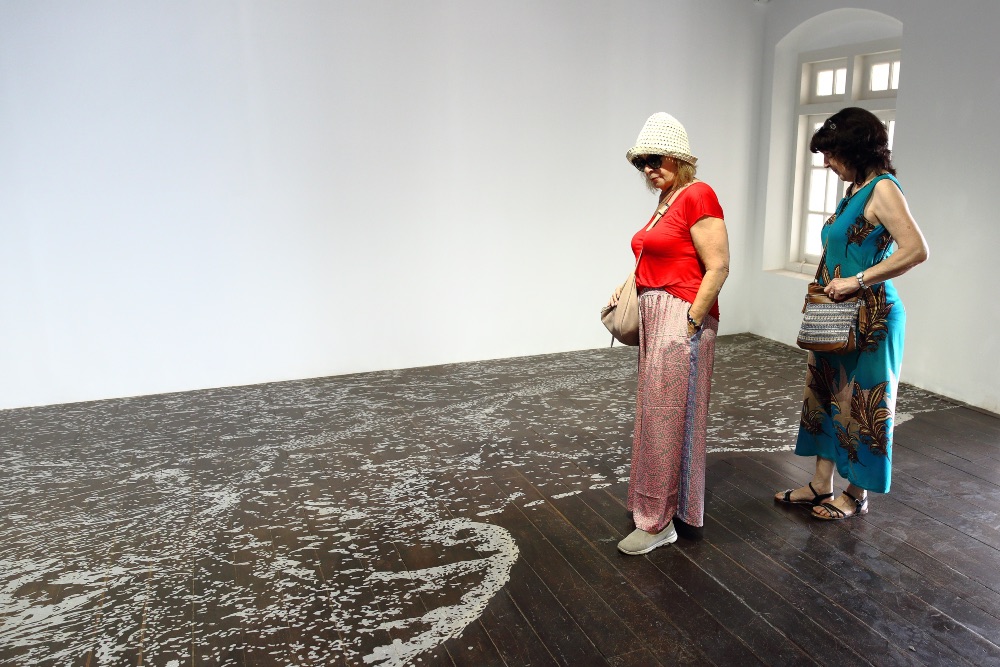
The sea, a motif in some of Hasan's earlier works- suggesting travel, togetherness, and vulnerability- returns in Kal (2025), which registers passages of time. Six small self-portraits that Hasan made in charcoal each year since 2020 resist the rigid measurements of passport-size photographs that fix identity, and chronicle the subjective physical and emotive transformations of the self over time. These temporal revisitations and back-and-forths continue in a site-specific floor drawing where Hasan retrieves the fleeting impressions on the porous substrate of memory, as reminiscences wash ashore and are reconstituted when remembered. Hasan renders a wave in thin metal leaves as it touches and retreats from the shore, and emerges from a corner onto the weathered wooden floor of a room overlooking the sea. Encompassing visually frozen rhythms, the work is animated by the subtle interplay of light reflected off the frothy surface, corresponding with the viewers' movements where the body, space, and image merge. Moreover, the proximal view of churnings enabled at the image's edge calls to the bustling activities and exchanges at the sea beyond the room. Between these precepts, Kal invites onlookers to reflect on their associations with water bodies and the coast. (Stuti Bhavsar)
FACEBOOK >>
INSTAGRAM >>
BIRENDER YADAV
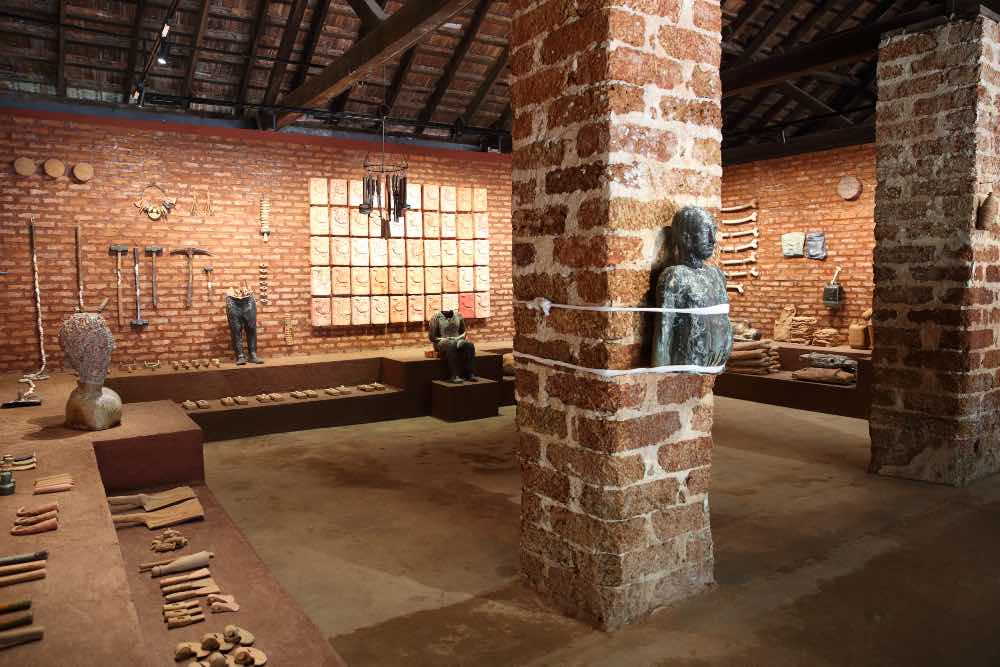
The lives and labour of seasonal migrant workers- particularly those working in brick kilns in Mirzapur, Uttar Pradesh-inform the fundamental concerns of Birender Kumar Yadav's artistic practice. Currently based in Delhi, he reflects on the living and working conditions of landless bonded labourers caught in a complex socio-economic system of extraction and exploitation. Through works in the mediums of installation, painting, sculpture, and photography, he reinterprets the many layers that shape these experiences, re-framing the materials, tools, and processes to contemplate questions of identity, migration, language, caste violence, and the exploitation of labour. Only the Earth Knows Their Labour (2025) reconstructs the atmosphere and structures of a kiln, without the workers. (Aparna Chivukula)
INSTAGRAM >
ADRIAN VLLAR ROJAS
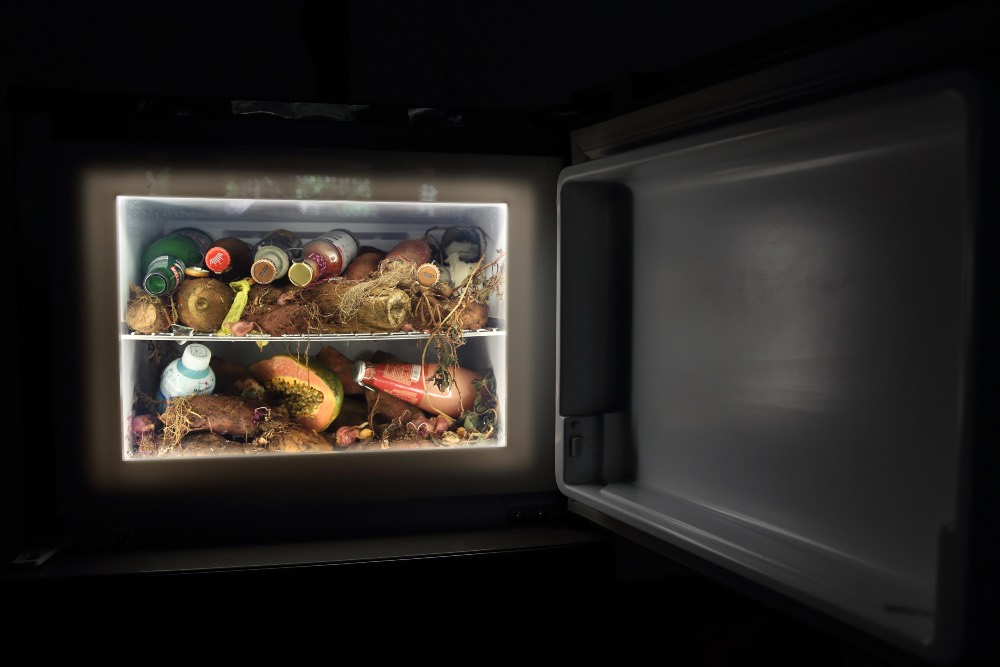
At the Kochi-Muziris Biennale, Villar Rojas presents untitled sculptures from the series Rinascimento (2015 - ongoing). At the Coir Godown in Aspinwall, visitors will encounter dated, obsolete models of refrigerators, their open freezer compartments transformed into vitrine - like displays of organic matter petrified in various states of decay and entropy. In compositions akin to those of vanitas paintings overwritten by the anaesthesia of ice and the corpulent growth of fungal life, we encounter frozen meat and farm produce, fish, and slices of fruit, beverages with branded caps, and sprigs of roots and leaves. These displays mimic the form of dioramas, condensing the vast and extractive biome of the Anthropocene into the contents of a domestic refrigerator, each material form in this assemblage a signifier of capitalism's reconstitution of the earth-from the mass production of farms to the expansive supply chains that grid the globe. Sourced intentionally from food supply vendors, these tableaux gesture at the toxic hybridity that marks life in the Anthropocene, blending elements of natural and processed food, juxtaposing the skin of fresh produce with the high-patina gloss of packaged bottles, connecting the machinic telos of the freezer with the rabid growth of fungi. The sculptures, dependent on electric supply and machinic efficiency, emanate a marcescent glow and are designed to default, inviting a barely perceptible onset of ruin that underscores the slow violence of ecological decline.. (Arushi Vats)
ARTIST PROFILE >>
ABUL HISHAM
Born in Thrissur, Kerala, and now based in Amsterdam, the Netherlands, Abul Hisham reconstructs personal memory and collective history into tangible and spatial forms. Hisham's engagement with sensory memory began in 2008 with an early project titled Constant Memories, in which he incorporated the scent of sambrani (Gum benzoin) to evoke the sombre mood of Indo-Islamic death rituals and devotional gatherings. At the Kochi-Muziris Biennale, he presents Healing Room (2025), an installation that transforms a ground-floor space in Aspinwall House into a multisensory environment. His composition includes painting, sculpture, fragrance, water, and taste, while orchestrating a ritualistic movement through the space. (Aswathy Gopalakrishnan)
FACEBOOK >>
INSTAGRAM >>
BIRAAJ DODIYA
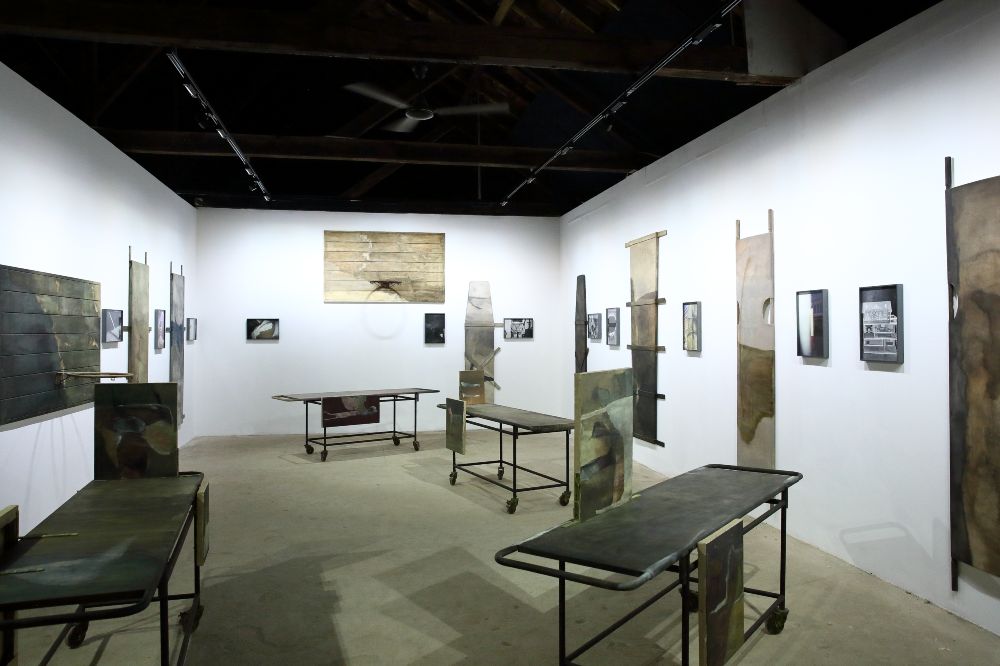
Biraaj Dodiya is a visual artist based in Mumbai, India. Interested in the overlaps between painting, drawing and sculpture, her work is influenced by forms and language around collapse, uncertainty and impermanence. For the Kochi-Muziris Biennale, Dodiya presents Doom Organ (2025), an installation that combines painted steel sculptures, small-scale paintings on linen, and photographs. Merging the diagrammatic and charged atmosphere of the sports arena and the silence of a mortuary, Dodiya composes a fictionalised space that explores the poetics of the dualities of our current moment and questions how we remember.
INSTAGRAM >>
ALI AKBAR
Ali Akbar PN's multimedia practice examines the built environments, syncretic beliefs, social anxieties, and cultural-economic transmissions within and between coastal Indian states such as Kerala, where he grew up, and Gujarat, his current base. In collages and historical reconstructions that entangle mythology with reality, he sutures fragments from oral histories, site-specific studies, and archival and museum records to present a counter-reportage on the subjugation of marginalised communities and historical distortions.
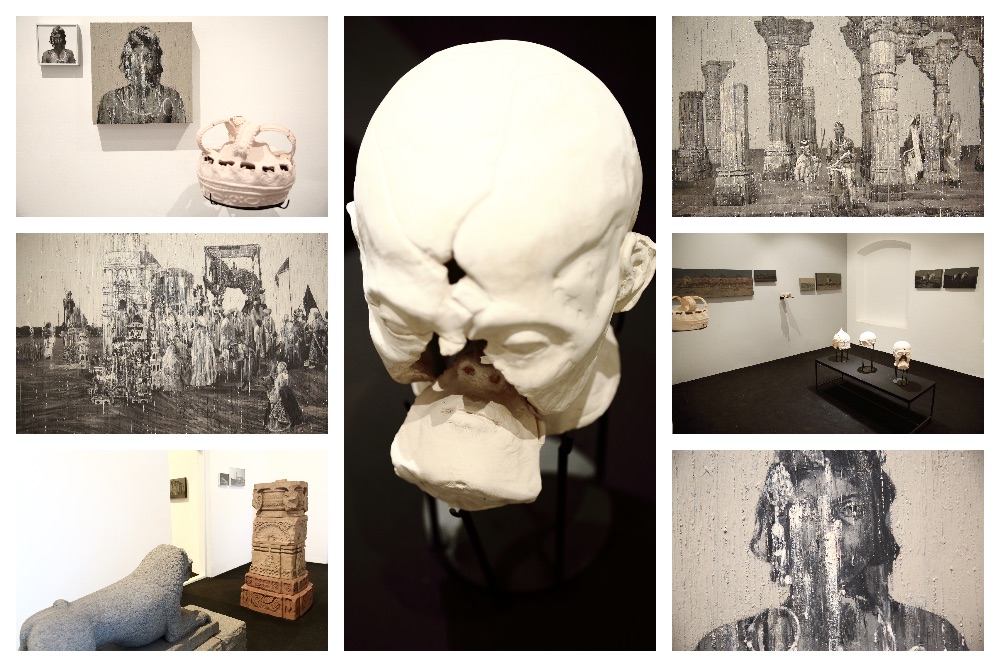
Reliquary (2024-ongoing) hosts remnants of inter- community relationships that have been shaped, witnessed, and recorded at religious and secular architectural sites in Gujarat, from Jami Masjid in Bharuch and Roza-Rozi Dargah Sharif near Mahemdabad to the premises of Vadodara's Maharaja Fateh Singh Museum. Paintings that reconstruct these sites and their syncretic contexts are punctuated by replicas of wartime objects and sculptures that stand in for the body politic. A ruined life-size pillar carved using two types of stone by Hindu and Muslim sculptors from Sirohi in Rajasthan-who have traditionally worked at multi-religious sites-anchors the space, with patterns that embellish its tiers, referencing temples and mosques in north-western India. Akbar salvages evidence of how, at times, communities refined, adapted, and shaped their traditions, as they encountered different cultural perspectives. These instances of social formation are now suppressed in the historical flattening undertaken by those in power..
INSTAGRAM >>
SHIRAZ BAYJOO
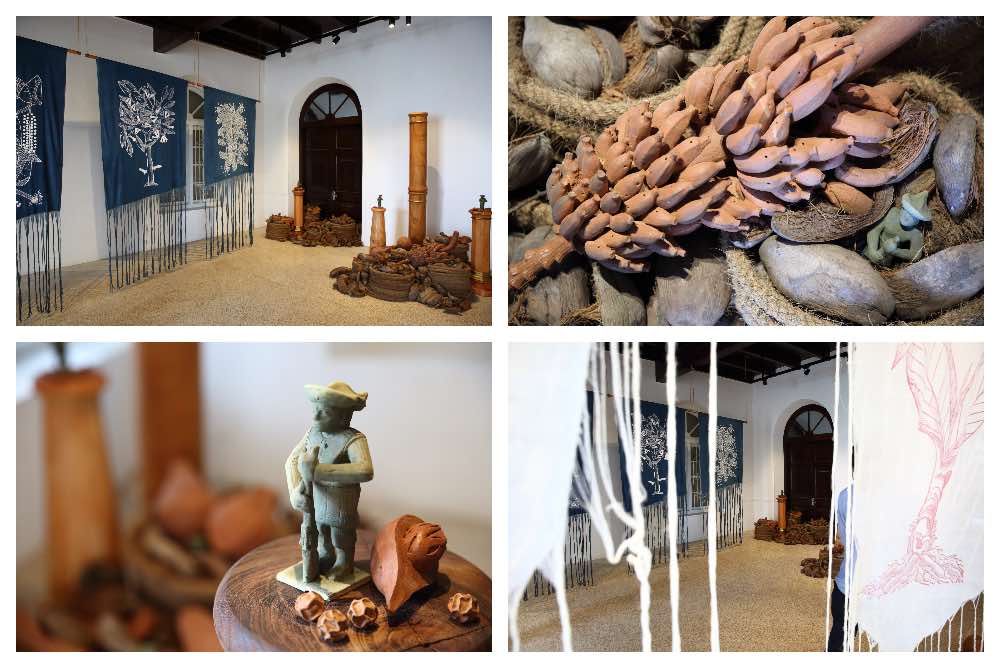
Shiraz Bayjoo, a multidisciplinary artist based in London, works across installation, performance, and film to foreground the Indian Ocean as a conduit for interrogating the histories of maritime trade and colonial extraction. Retrieving resistant oceanic imaginaries, his works unravel the entanglements between geopolitics and ecology, examining exchanges between plantations and botanical gardens: sites of colonial control and tools of territorial expansion. As resilient carriers of communal memories, textiles dialogue with mnemonic vessels such as photographic documents, botanical specimens, and architectural motifs gleaned from family albums, institutional archives, and oral histories. These assemblages recover lesser-known narratives of enslavement and the displacement of communities, cultivating dialogue and reconciliation. (Stuti Bhavsar)
INSTAGRAM >>
SMITHA M BABU
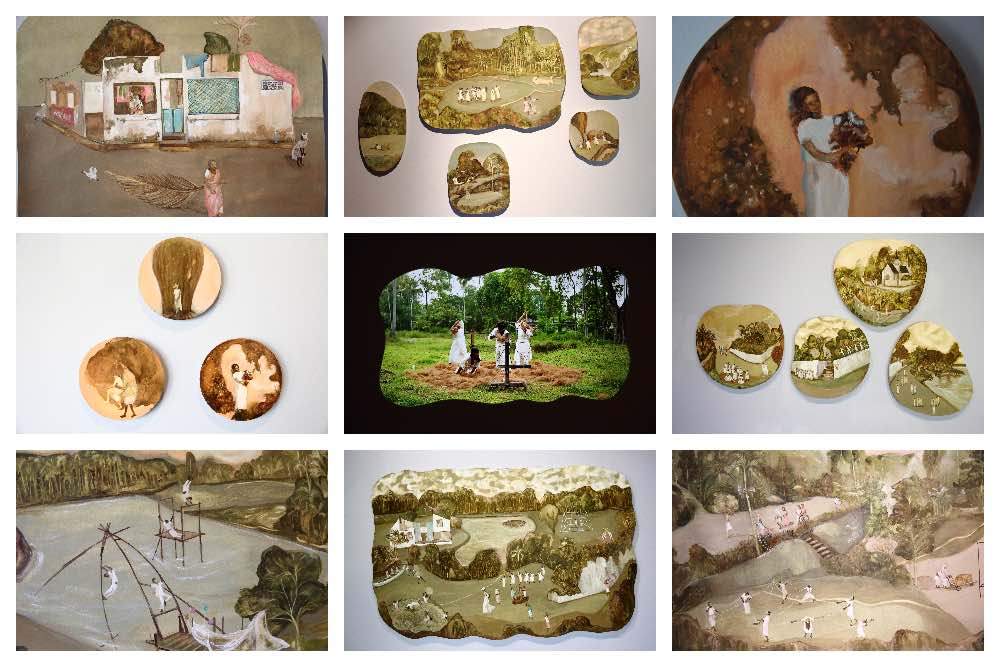
With a theatre career spanning over two decades, Smitha M Babu extends her pictorial practice into the performative space. For the Kochi-Muziris Biennale, she presents Pakkalam (2023-ongoing), a multidisciplinary project rooted in her lived experiences along the Ashtamudi Lake in Kollam, and in her close observations of the working-class life centred on the region's coir- making traditions. Integrating her watercolour works with live theatre, she expands the aesthetic boundaries of both mediums.Alongside nearly thirty paintings exhibited at Aspinwall House, Smitha and her four-member team stage a fifteen-minute performance over three days, set against the sound of Kollam's coir-weaving spaces. They use the raw materials of coir production, such as coconut husk, coir fibre, and the ratt machine, as props and instruments. Setting the background and cadence for her performance is the collation of sounds recorded from the banks of Ashtamudi Lake-the rhythm of the spinning wheel, the lapping of lake water around the coir sheds, and the clamour of workers. (Aswathy Gopalakrishnan)
FACEBOOK >>
INSTAGRAM >>





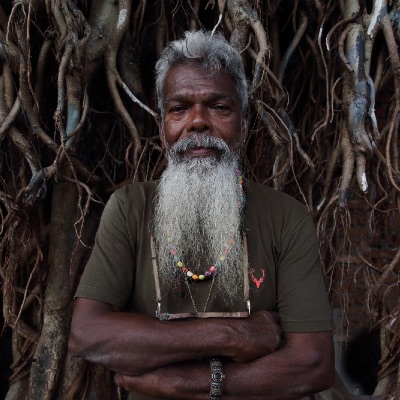
Founder & Director of Ayurveda Trails, healing collection of (extra)ordinary people and their stories, whose experiences are transferred into various trails shared by travelers.
SHILPI RAJAN: FIGURE, FIELD & FACT
Aazhi Archives and Uru Art Harbour are proud to present Shilpi Rajan, one of the living legends from Kerala, a self-taught artist hails from Thrissur, create his sculptures from natural materials in spirit of making shapes, enduring life and humour layered with tragic marks.

Theyyam is a vibrant and colourful form of ritualistic worship that is deeply rooted in the culture and traditions of Kerala, India. This living tradition involves elaborate rituals, music, dance, and vibrant costumes that bring to life the divine spirits being invoked.

What if precarity is the condition of our time or, to put it an other way, what if our time is ripe for sensing precarity? What if precarity, indeterminacy, and what we imagine as trivial are the center of the systematicity we seek?
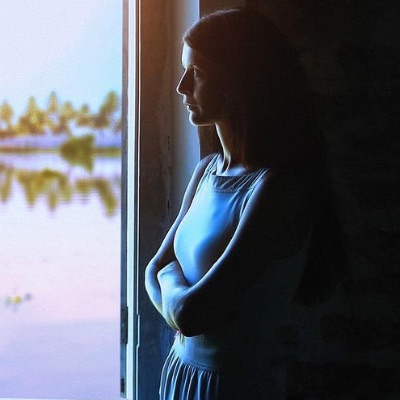
INDIA IN STYLE: 100 DAYS OF ART
India in Style, was created as part of Ayurveda Trails & Journals. During the Kochi-Muziris Biennale 2025-26, our founder Zuzana Zwiebel introduces one artist, event, or organisation every day, Here are the first 25 artworks. Let us inspire you!
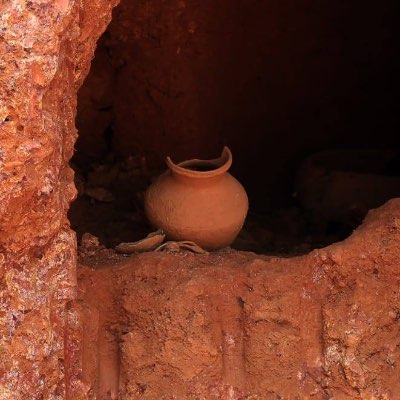
Can prehistoric artifacts be art? Come see for yourself at Kara in Fort Cochin! Mohamed A’s photographic images of excavations and the excavated - real, yet mysterious and enigmatic - take us on a journey into Kerala’s prehistoric past.

KOCHI-MUZIRIS BIENNALE 2025-26
The 6th edition of the KMB 2025 is curated by Nikhil Chopra with HH Art Spaces, an artist led organisation based in Goa. Chopra is a multidisciplinary artist whose practice interweaves performance, drawing, photography, sculpture, and installation.
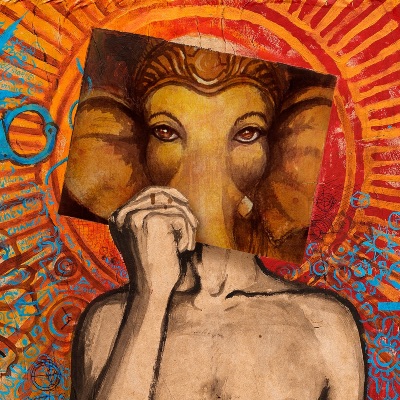
Ganesha is not for the artist a religious figure, it is a very personal almost incomprehensible connection, which has become a relationship that he commonly describes as being a mirror to the soul. Ganesha, in this case, is about portraying the image of a formless energy.

Chilean poet and featuring artist at the Kochi Muziris Biennale 2016 on the possibility of an artistic response to the human crises of our time, including the refugee crisis surrounding the conflict in Syria. The sea, which became a grave for hundreds of people, including children.
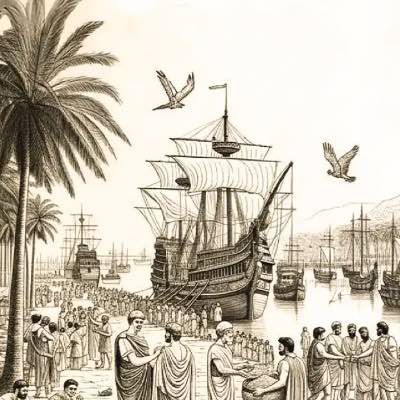
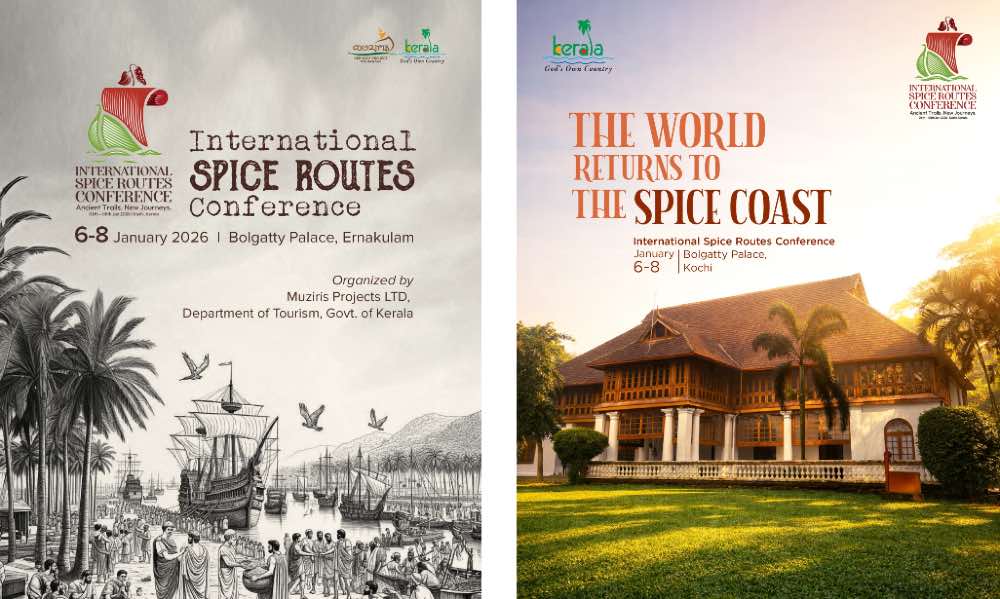
INTERNATIONAL SPICE ROUTE CONFERENCE 2026
Welcome to the First Edition of the Spice Routes Conference organized by the Muziris Heritage Project, Government of Kerala January 6-8, 2026 in Bolgatty Palace, Kochi. Step into a world where history, culture, and global connections converge.
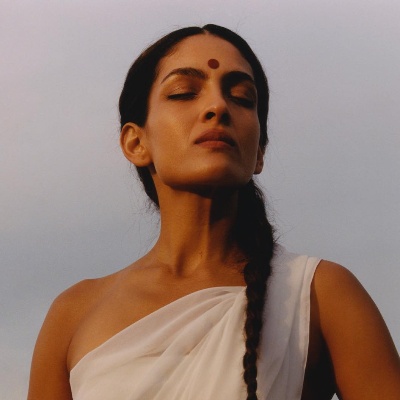
A new beginning is always infused with hope. Life is full of moments that we believe to be beginnings only because of the presence of hope. A physical symbol of these moments of hope is the flower. The films attempts to capture the emotion of these beginnings.
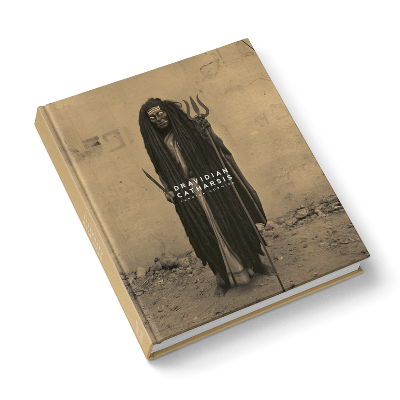
Dravidian Catharsis is the fruit of this deep immersion in the culture, the theatre, the traditions, and the soul of this mythological universe of the Tamil people. The powerful presences of spirits and living gods are embodied under masks.

Legend says that somewhere deep in the forest of the Himalayas is a strange bird that lays psychedelic eggs. Eating them will give you highly vivid hallucinations. The indigenous shamans believe that these visions are from your past life.
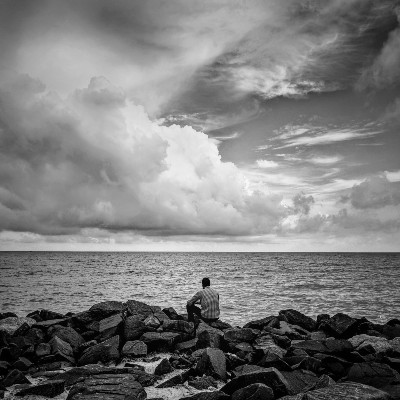
Ryuichi Sakamoto passed away this year on 28th March leaving behind a legacy of innumerable musical compositions that'll keep him alive in countless hearts across the world. However, I'll always be haunted by the fact that I couldn't let him know that I'm still alive because of his music along with many more.
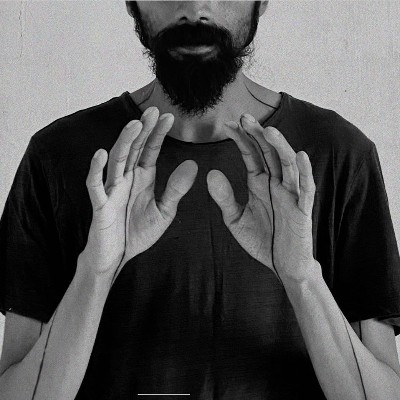
Search for the questions to the answers written on the skin...and i asked. am i connected to the deep inside you? with the invisible roots from the layered skin of you? all the energy you transfer to the heart of your thoughts?i asked again am i still connected?
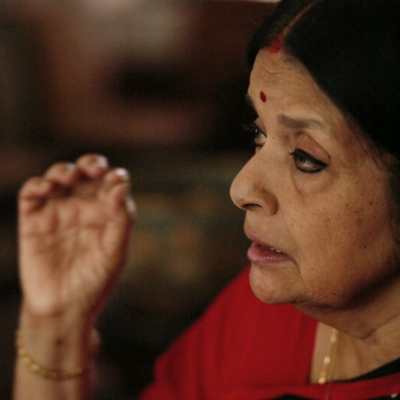
01: Ayurveda in Travancore Kingdom
If you expect stories which starts: Once upon a time, there was a princess... stop reading. Her Highness Princess Gouri Parvathi Bayi of the Travancore Royal Family will introduce us very modern and open minded view on today's Kerala society and ayurveda.

Stories of communities about origin, spread and apocalypse being presented through episodic memories, narrative and visual texts, travel writings, murals, divine objects, church paintings, and songs provide a dense and myriad repository of historical and artistic imagination.