We use cookies to optimise our website functionality and give you the best experience possible. Please, accept our Terms and Conditions. ACCEPT
IN THE TIME OF KOCHI-MUZIRIS BIENNALE (KMB) 2025-26
INDIA IN STYLE: DAY 26-50
India in Style, created as part of Ayurveda Trails & Journals, does not want to be anything else but an artistic expression of a healthy lifestyle inspired by ancient healing traditions, creating harmony with the dynamics of contemporary life. During the Kochi-Muziris Biennale 2025-26, our founder Zuzana Zwiebel introduces one artist, event, or organisation every day, which can inspire all of us. Enjoy the journey!
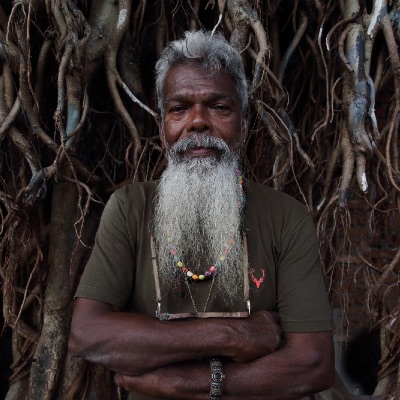
Shilpi Rajan, one of the living legends from Kerala and a self-taught artist hailing from Thrissur, has worked organically in clay, cement, wood, bamboo, iron, laterite, and many more materials, with a spirit of making shapes, enduring life, and humour, layered with tragic marks. His works have been recognised as an ongoing resistance with a remarkable sense of revolting against the established notions of academic art, and that makes him an echoing presence in contemporary art. Now, he is proudly presented in front of a global audience by Aazhi Archive and Uru Art Harbour. Read more >>
SHILPI RAJAN
Aazhi Archive and Uru Art Harbour proudly present the retrospective exhibition of Kerala's legendary artist Shilpi Rajan. Beginning his journey as a mechanic in pursuit of a livelihood, Rajan's natural affinity for art ultimately drew him into sculpting-an evolution shaped by instinct rather than formal training. Rajan has worked with an impressive range of materials, including newspaper, sheet metal, clay, cement, wood, bamboo, coconut and areca nut tree, iron, granite, and laterite. His sculptures often reflect the moods and experiences he lived through at the time of their creation, rather than adhering to fixed expressions or academic conventions. He believes that sculpture, like life itself, cannot bear a permanent mood. The influence of Kerala's folk and tribal traditions is strongly visible in his human figures, which carry echoes of local deities and indigenous art forms
SHILPI RAJAN: FIGURE, FIELD & FACT >>
AAZHI ARCHIVE >>
URU ART HARBOUR >>
Can pre-historic artifacts be art? Come see for yourself at Kara, as we walk through artist Mohamed A’s photographic journey with archaeology, its sites and its practices.
A Mohamed’s photographic images of excavations and the excavated - real, yet mysterious and enigmatic - take us on a journey into Kerala’s prehistoric past. It is the story of how we came to be what we are, told through the archeological sites, architectures, implements and artefacts. They bring into vision sediments and remnants of the great voyages of yore, and also human engagements with life and imaginations about after-life. Read more >>
ARCHEO LOGICAL CAMERA BY MOHAMED A
Kara Gallery, Ridsdale Road on Parade Ground, Fort Kochi
From 6 December 2025 to 30 January 2026 - EXTENDED TO 30 MARCH 2026
Show in collaboration with Aazhi Archives, URU Art Harbour, Department of Archaeology (Government of Kerala), Sandeep & Gitanjali Maini Foundation, and Muziris Heritage Project.
ARCHEO LOGICAL CAMERA BY MOHAMED A >>
AAZHI ARCHIVE >>
URU ART HARBOUR >>
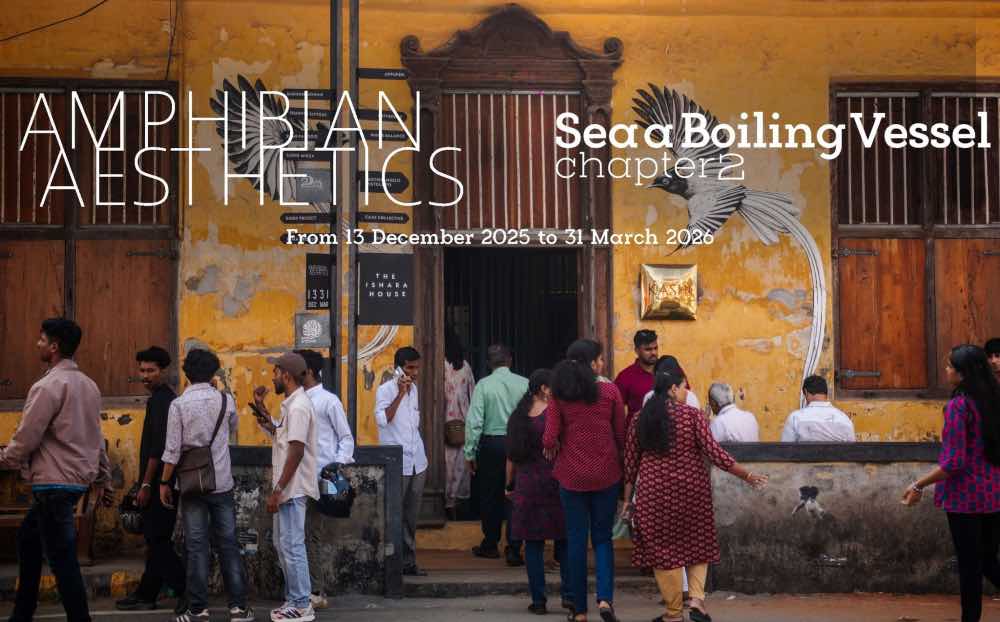
Across installations, performances, talks and conversations at Kashi Hallegua House and Uru Art Harbour, the works chart the residual currents that shape our collective imaginaries, maritime trade routes, exilic journeys, ecological disruptions, and the intricate hydrosocial webs that bind life across species. In doing so, the exhibition will offer not just art objects, but propositions for thinking with porousness, with instability, and with the fragile ecologies we inhabit. Read more >>
URU ART HARBOUR
URU is envisioned as a vibrant and interactive hub for visual arts, literature, music, and philosophy. URU seeks to be a space for collaboration and a continual hub for artistic, cultural, and intellectual exploration to move the dialogue about (and of) local cultural specificities from the margins to the centre and to be a free space for artistic expression, critical inquiry, and creative disruption. URU’s activities include publications, exhibitions, residencies, screenings, music, design interventions, discourses, workshops, and educational initiatives. URU is situated in Mattancherry, Kochi.
Read more >>

AAZHI ARCHIVES
Aazhi Archives is a collective of artists, writers, and scholars, working at the intersection of art, knowledge, and community. Since 2022, we have explored Kerala’s oceanic histories and cultural networks through exhibitions, workshops, and collaborative research. Guided by the mission Art + Knowledge + People, we bring artists, historians, and local communities together to reimagine shared pasts and possible futures.
Read more >>
MICHELANGELO PISTOLETTO: DIVISION AND MULTIPLICATION OF THE MIRROR
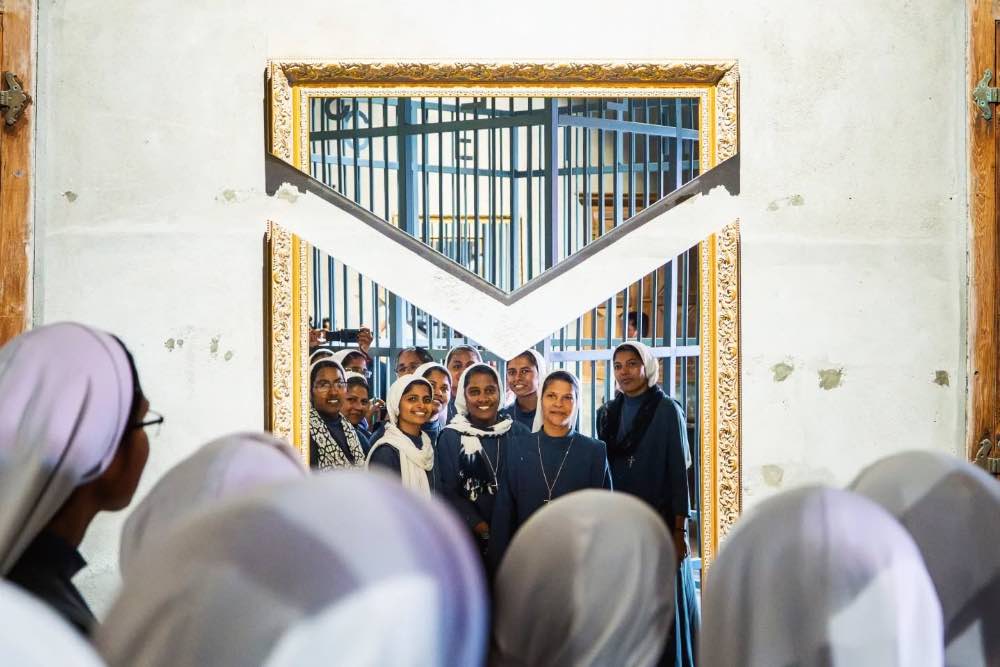
Four works are presented in this exhibition from Michelangelo Pistoletto's series Division and Multiplication of the Mirror. The series was first presented in 1978 alongside an accompanying text by the artist that began with a simple observation that a mirror can reflect everything except itself. By dividing a framed mirror into two sections and gradually moving the halves along the axis of division, the reflected images multiply as the angle between the parts narrows. This optical effect becomes a starting point for Pistoletto's explorations, where the principle of division extends beyond the visual. On a broader level, it gestures toward the universal phenomena of organic growth and, socially, toward sharing as an alternative logic to accumulation and exclusion. In these works, reflection, division, and multiplication operate simultaneously as aesthetic phenomena and as metaphors for relational, collective, and regenerative processes.
AAZHI ARCHIVE >>
URU ART HARBOUR >>
ISHARA ART FOUNDATION >>
MICHELANGELO PISTOLETTO: THE FREE SPACE
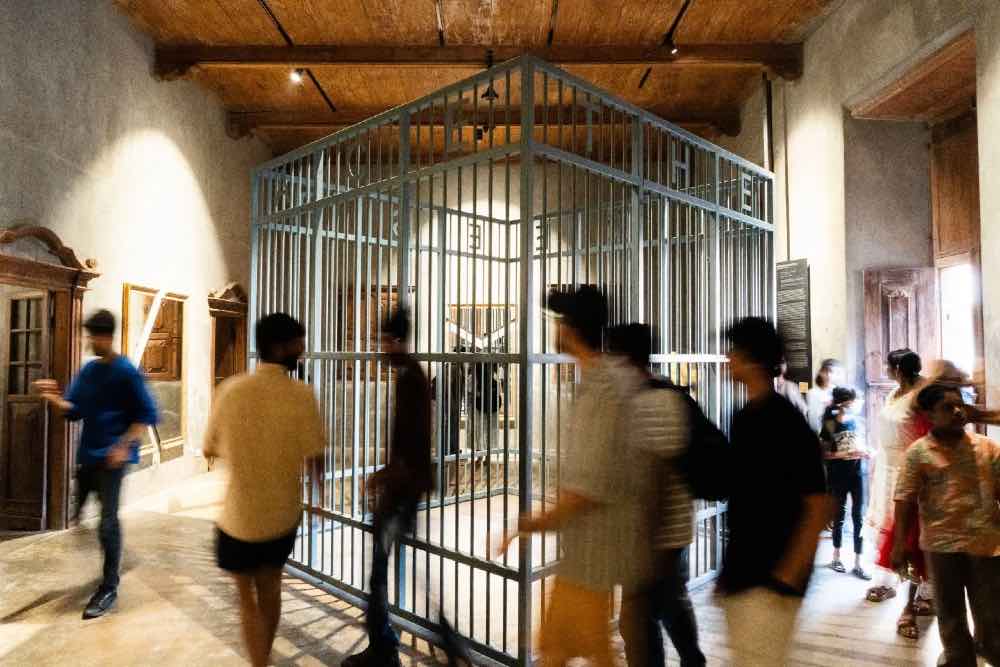
The Free Space is a large square steel cage with no entrances, marked with the words 'Free Space' along its upper edge. The work was first conceived in Michelangelo Pistoletto's 1976 book 'One Hundred Exhibitions in the Month of October', which outlined ideas and brief descriptions of one hundred works or exhibitions that he would later bring into physical form. The first realization of The Free Space occurred in 1999 through a collaboration with inmates at San Vittore prison in Milan, who executed and installed the work in the prison courtyard. The motif of the cage recurs throughout Pistoletto's practice, appearing in his 'Mirror Paintings' as a counterpoint to the openness of reflective surfaces that integrate viewers and surroundings. It also resonates with the multidisciplinary art group Lo Zoo, founded by Pistoletto in the 1960's, where enclosures and boundaries were explored conceptually. The Free Space continues this inquiry, juxtaposing containment and freedom, isolation and engagement, prompting reflection on social, spatial and relational possibilities.
AAZHI ARCHIVE >>
URU ART HARBOUR >>
ISHARA ART FOUNDATION >>
RATHEESH T
Ratheesh T's work arises from an acute awareness of the social fractures and political anxieties in contemporary India. Ratheesh's paintings often reflect this tension, tracing how Brahminical patriarchy-long embedded within the social fabric-now takes overt political form through religious communalism. His works speak to the ways in which ideology infiltrates everyday life, determining what is visible, sayable, and even desirable, while erasing dissent and difference.
Ratheesh's practice brings together figures who have learned to adapt and endure-people who wear whatever "costume" survival demands. They may be migrant labourers, mythic archetypes, or ordinary citizens navigating the flux of history. His characters embody the pragmatism of living through crises, carrying with them traces of historical memory and the improvisations of everyday life. The catastrophic floods of 2018, among the worst Kerala has faced in a decade, and the crippling dislocations brought by the Covid-19 pandemic in 2020, serve as critical backdrops to Ratheesh's recent explorations. Through these events, he finds both tragedy and revelation: the collapse of infrastructure and governance on one hand, and the resurgence of human resilience and solidarity on the other. In his canvases, these contradictions are rendered with irony and tenderness, revealing the fragile interdependence between nature, society, and politics. In this way, Ratheesh T's work becomes a mirror to our times-anchored in Kerala yet resonant across India's larger social landscape. It foregrounds the poetics of survival amidst ideological violence and environmental collapse, reminding us that even in moments of despair, the possibility of empathy, self-reflection, and collective endurance remains. In doing so, it reminds us that survival today is not about resistance alone, but about learning to breathe differently.
AAZHI ARCHIVE >>
URU ART HARBOUR >>
ISHARA ART FOUNDATION >>
APPUPEN
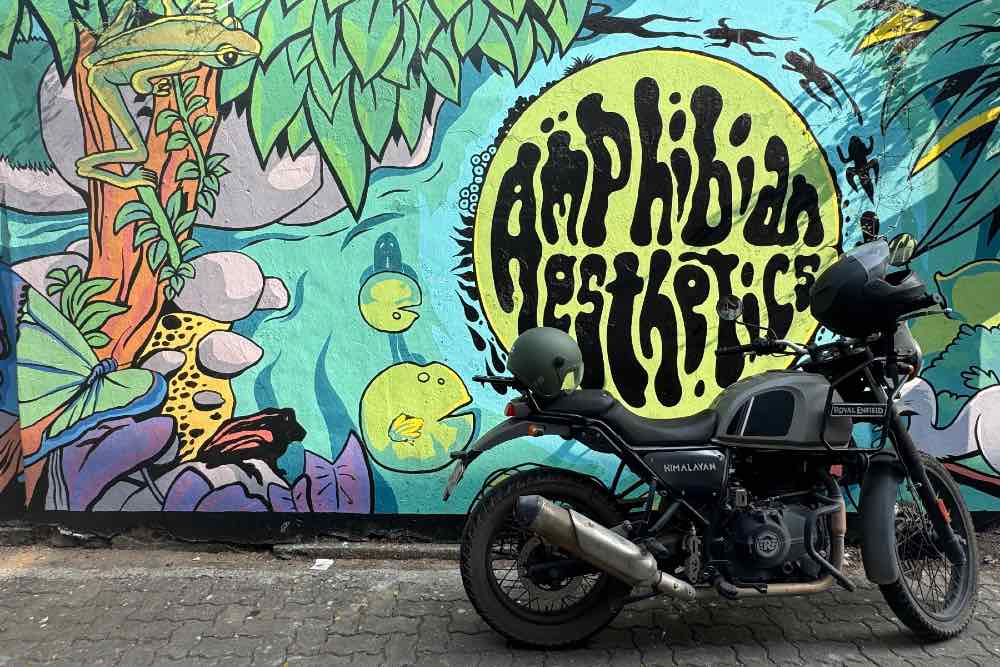
George Mathen's work unfolds as a multi-platform narrative circulating online, in print and through murals across Kochi's streets. Marked by dark humour, pop aesthetics, and biting satire, it probes identity politics, surveillance, ecological unease and the manufactured logics of propaganda.
Set within a fictional story of a sinking economy charged with nationalist fervour, the series follows Amfy B. N. Jose, who takes up work in a government's aggressive campaign against the elusive vigilante known as Frogman. Seeking stability and success, he fabricates fear through staged news and targeted misinformation, quickly earning favour with his crony-capitalist superiors. Yet by night, he becomes the very figure he is tasked with vilifying. Caught between ambition and compromise, Amfy embodies the contradictions of our era, half-belief and half-doubt, convenience over conviction, amphibious in ideology and identity
AAZHI ARCHIVE >>
URU ART HARBOUR >>
ISHARA ART FOUNDATION >>
SHANVIN SIXTOUS
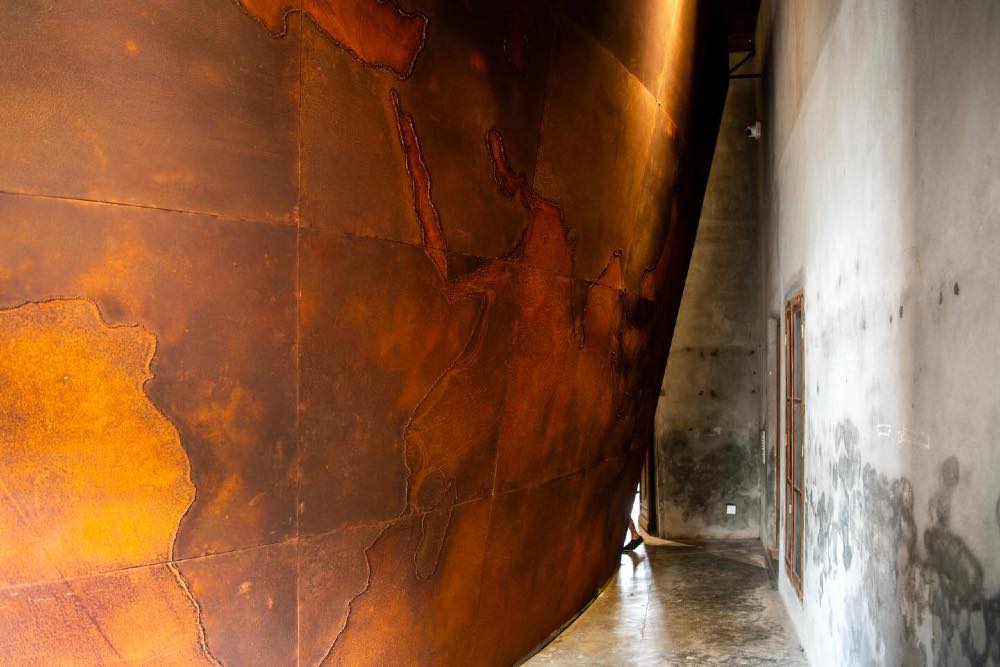
Shanvin Sixtous's installation uses steel to explore the hull as both material and metaphor within Kochi's amphibious landscape. The hull, always partly submerged, embodies movement, containment and the continuous negotiation between land and water. It bears the imprints of labour and migration, carrying memories of journeys both chosen and coerced. Its polished interiors and corroded exteriors map historic routes of trade and belief, revealing tensions between visibility and concealment, memory and erasure.
Bringing the geographies of the Mediterranean, Gaza, the Aegean and the Bay of Bengal into dialogue, 'In, Between' reflects ongoing displacement shaped by overlapping histories of commerce and conflict. Rather than resolve these currents, the work lingers in uncertainty, suggesting an amphibian mode of existence that is adaptive, interdependent, and alert to fragile, shifting grounds.
AAZHI ARCHIVE >>
URU ART HARBOUR >>
ISHARA ART FOUNDATION >>
CAAS COLLECTIVE - CITY AS A SPACESHIP (CAAS) - SUSMITA MOHANTY, ROHINI DEVASHER, SUE FAIRBURN, BARBARA IMHOF
City As A Spaceship (CAAS) works at the thresholds between Earth and space, using remote and extreme environments as laboratories for reimagining how humans might live in the future. Across four interconnected works, the collective explores amphibious states-where land, sea, atmosphere, and cosmos merge. Together, these works invite viewers into an amphibious imagination-one that unsettles boundaries and speculates on reciprocal futures between sea, Earth, and space.
AAZHI ARCHIVE >>
URU ART HARBOUR >>
ISHARA ART FOUNDATION >>
KABIR PROJECT
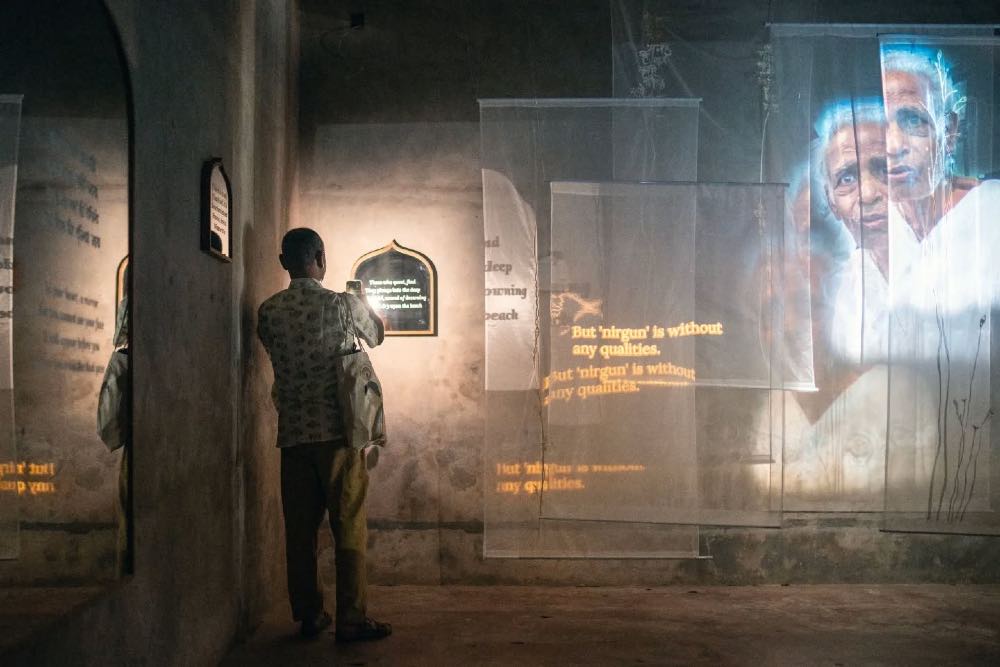
Kabir says this city that promises many wonders is not far away it is within. The medieval mystic poets of our land were fiercely iconoclastic and their poems challenge the bigotry, religious sectarianism and the moral hypocrisy of their times and ours. They consistently urge seekers to turn within to find answers. Their poetry does not reject the world but moves fluidly between the outer and inner, the social and the spiritual, the body and the spirit - between the 'beautiful form' and the 'formless king' it drapes.
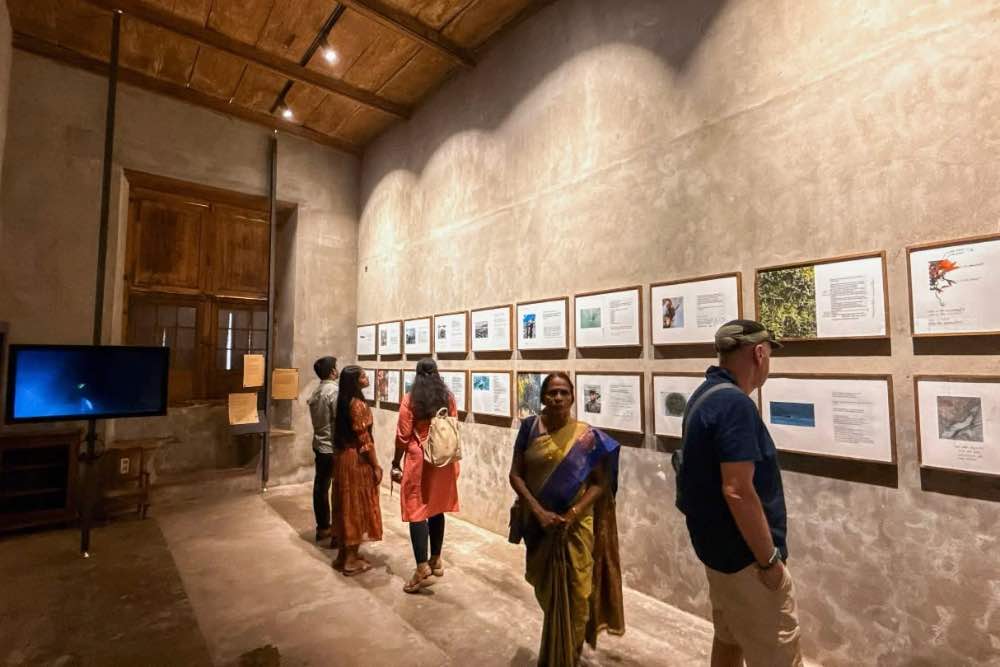
Many such metaphors, images, couplets and songs from this 600-year-old wisdom tradition are found as digital fragments on Ajab Shahar - an archive of mystic poetry built over 23 years. These songs and poems have traveled across many centuries and landscapes to find their way to us; the same poem shapeshifts to appear in vastly different languages and cultures, dancing to a new rhythm. From Malwi to Sindhi, Urdu to Bengali, these poems have crossed boundaries of language, faith, and region; they move through marketplaces, shrines and village gatherings, finding new life in each retelling.
The mystics insist on an indescribable, ephemeral truth accessed only in temporal experience and lost to language afterwards. They urge us towards an experience that renders you dumb and groundless. And yet, they keep saying 'what cannot be said'. They go on mocking and exhorting us, deploying words even while insisting that they are worthless. This is the play between the Akath (unsayable) and the Katha (the said).
With this exhibition of the archive (a first for the Kabir Project), we mull the apparent irony of trying to freeze an amphibian and shifting tradition that insists on the futility of such efforts. We dance between two worlds: the fixed and fluid, the written and oral, the scripture and the song. Perhaps, wandering this city online or through these rooms, you may find some signposts to the city within.
AAZHI ARCHIVE >>
URU ART HARBOUR >>
ISHARA ART FOUNDATION >>
DIMA SROUJI
Dima Srouji (b. 1990) is a Palestinian architect, artist, and researcher based between Ramallah and London, whose practice approaches the ground as a living archive. Working with glass, text, maps, archival material, plaster casts, and film, she approaches each medium as an evocative object and emotional companion. Her projects experiment with reframing histories of the land by reshuffling strata and retelling stories from perspectives long suppressed, often through the material cultures of glass and stone. Srouji collaborates closely with archaeologists, anthropologists, sound designers, glassblowers, and stonemasons. She has exhibited internationally, including at the Venice Biennale, Sharjah Architecture Triennial, the V&A, and the Palestinian Museum. She teaches at the Royal College of Art, focusing on archaeological landscapes as urban sites.
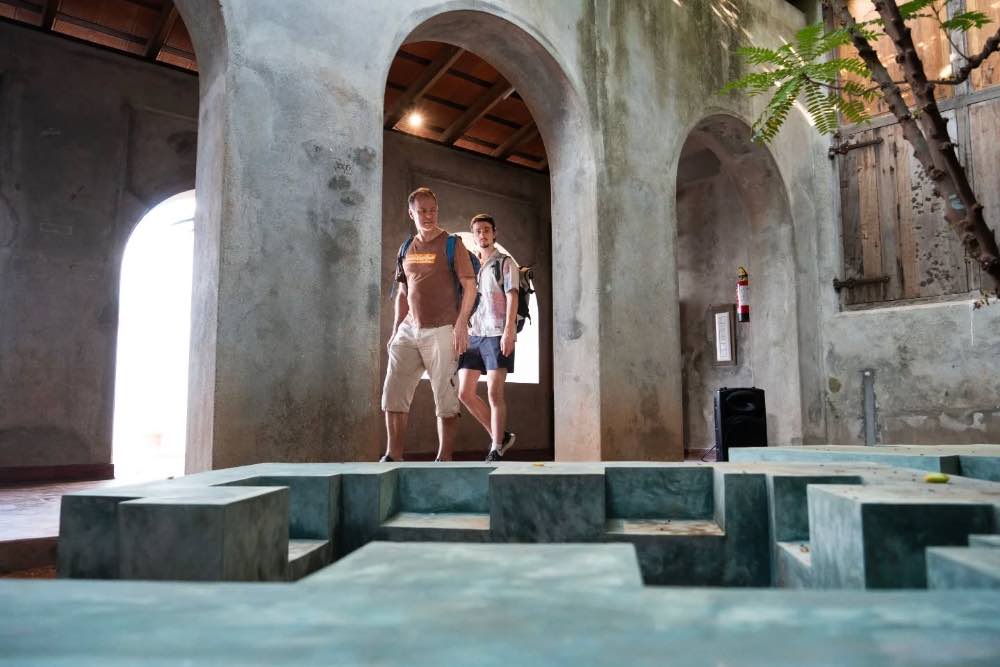
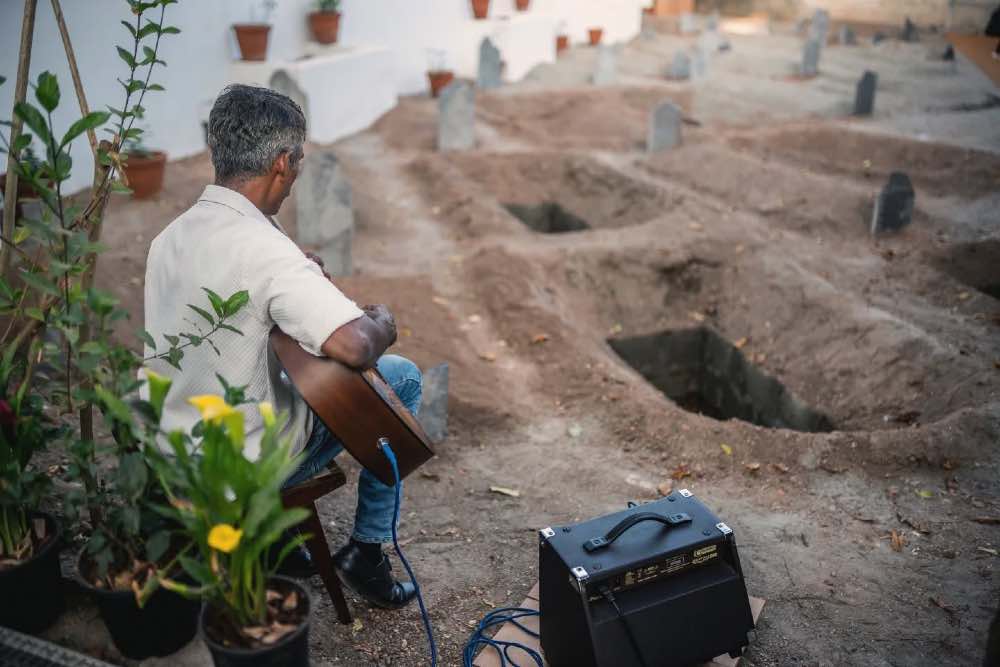
Foundations is a sonic and spatial composition tracing what remains and what has been erased from the ground in Palestine. The installation begins with the plan of an exhumed tomb from Ancient Gaza, excavated in the 1930s. Its outline is reimagined as a returned monument – a ground that refuses disappearance. The sound layers reversed recordings from the unfolding genocide, moving past October 7th 2023 to expose the colonial continuum across generations. It ends with an interview with the artist’s grandfather, played backwards, as he recalls life in Palestine during and before the Nakba. A film of archival montages peels away layers of colonial history from present to past. Foundations dwells in reversal, creating a space for collective listening, holding both comfort and discomfort within an archaeology of the lost and the lasting.
AAZHI ARCHIVE >>
URU ART HARBOUR >>
ISHARA ART FOUNDATION >>
SHILPA GUPTA
Shilpa Gupta (b. 1976) is an interdisciplinary artist based in Mumbai, whose works span installation, video, sound, performance, and public intervention. A graduate of Sir J.J. School of Fine Arts, her practice examines how states, institutions, and social structures regulate identity through borders, censorship, and surveillance. Gupta’s works frequently use voice, text, and interactive technologies to foreground the emotional dimensions of control, inviting viewers to participate in, and question, systems of power. She blurs distinctions between public and private space, often working with ephemeral materials that circulate beyond the gallery. Gupta has exhibited internationally at the Tate Modern, MoMA, Centre Pompidou, and the Ishara Art Foundation, and in biennales in Venice, Berlin, Gwangju, and Kochi.
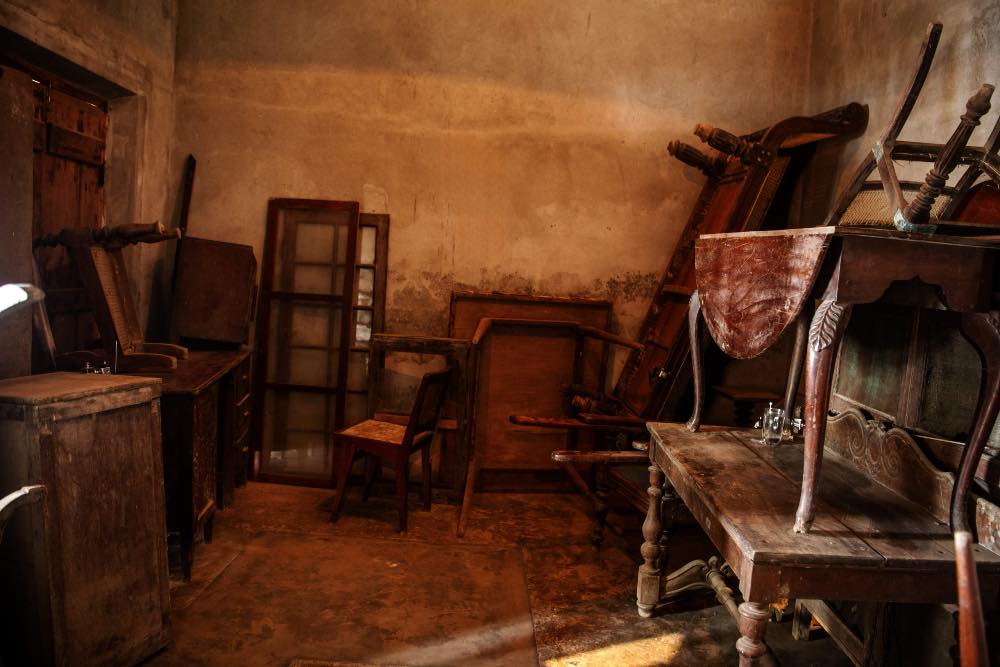
Shilpa Gupta’s site-specific installation invites viewers into two small, intimate rooms where everyday spaces – found furniture, window glass panes, tabletops – become resonant instruments. During the site visit, as she walked through these spaces, instinctively tapping the surfaces, Faiz Ahmad Faiz’s protest song that became an anthem of resistance ‘Hum Dekhenge’ emerged. In a climate when authoritarian regimes suppress dissent, silencing public protest and forcing voices indoors, sound here adapts – slipping between public and private realms, seeping into walls, and inhabiting domestic objects. The work recalls Gupta’s earlier engagements with imprisoned poets, whose words endure through echo and mutation. The recurring stone returns as a ground-born utterance, recalling works such as Untitled (Wives of the Disappeared) (2006) and Song of the Ground (2017). Combined with drinking glasses collected from the neighbourhood, through repetition and resonance, the installation becomes a chant of persistence, a resilient, amphibious, and refusing disappearance, asserting presence across time and space.
AAZHI ARCHIVE >>
URU ART HARBOUR >>
ISHARA ART FOUNDATION >>
RAMI FAROOK
Rami Farook (b. 1981) is a self-taught artist and curator based in Dubai. His practice centres on collaboration, socio-cultural inquiry, and process rather than predetermined outcomes. He entered the arts by founding ‘Traffic’ (2007), a cultural platform supporting emerging creative scenes. Shifting toward artmaking in 2011, Farook approaches interdisciplinary media with emotional intensity, merging conceptual, documentary, and fictional modes. His work probes social behaviour, systemic histories, and the responsibilities embedded in cultural production. Using art to inform, entertain, and prompt critical reflection, he blurs boundaries between authorship and audience. Farook remains an active presence in the UAE’s artistic landscape through participatory projects, curatorial collaborations, and cultural stewardship.
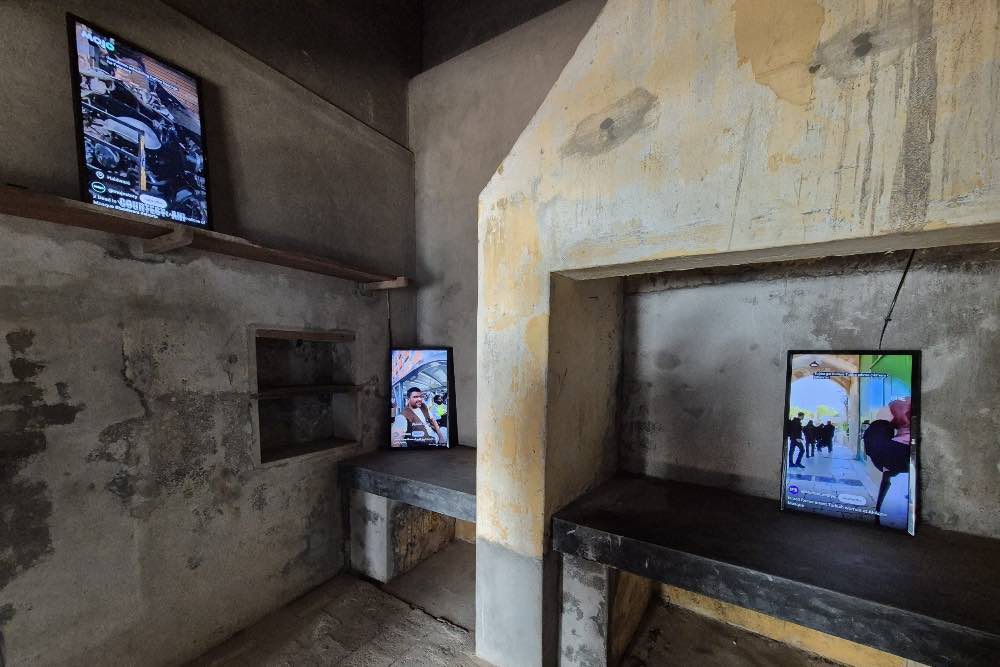
Three Acts of a Masjid gathers more than two hundred vertical-format videos from public online sources, moving between destruction (of mosques razed in India, China, and Gaza); preservation (Cheraman Masjid in Kerala that is the oldest mosque in India and Masjid Quba, each upheld through centuries of devotion; and, protection (most urgently at Al Aqsa, where guardianship unfolds in real time). Each video carries a pulse of its own while opening into the next, with sounds intersecting in an unsettled field.
Across these fragments, the mosque emerges not only as architecture but as a witness to resilience amid forces of erasure and change. Drawn from user-generated content and news media spanning historic centres and neighbourhood mosques, the work reflects on the endurance of sacred spaces and the tension between what is built, what is lost, and what continues to be defended.
AAZHI ARCHIVE >>
URU ART HARBOUR >>
ISHARA ART FOUNDATION >>
ZAHIR MIRZA
Zahir Mirza (b. 1966) is a Mumbai-based creative professional with over three decades of distinguished experience in India’s advertising industry. Having led major campaigns for brands such as Bajaj, Lifebuoy, Liril, Surf Excel, ICICI Bank, Sunsilk, Standard Chartered, and Kingfisher, he has held senior positions at Mudra Communications, Lowe Lintas, J. Walter Thompson, and Dentsu Aegis, where he served as Managing Director of Doosra Brand Communication Since retiring from agency life, Mirza has dedicated himself to education, focusing on creativity, innovation, and new approaches to learning. He has played a pivotal role in shaping the emerging DeNovo University at the Sir J.J. School of Art campus, chairing the committee that developed its master’s program and leading its delegation to the Ministry of Education A licensed instructor in creativity and innovation, he currently teaches at Sir J J School of Art and other leading institutions while using Instagram as a platform to share creative knowledge with younger audiences.
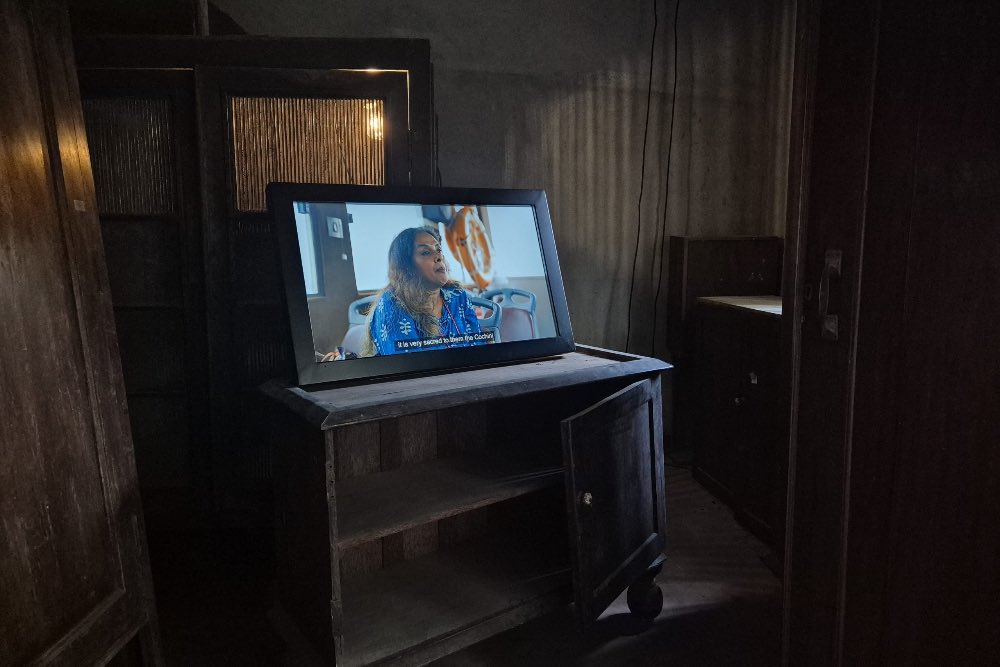
Kerala’s waterways have long connected the region internally and linked the subcontinent to the world through centuries of trade and cultural exchange. Languages, cuisines, and artistic practices flowed along these channels, creating a rich tapestry of flavours, stories, and sensory experiences. These living arteries shape both movement and intellect, tracing histories of commerce, power, and culture.
Boatcast, a self-explanatory portmanteau, takes these waterways as its stage, hosting a series of conversations aboard Kerala’s iconic boats. Moderated by Zahir Mirza, a media veteran and artist exploring digital connections, the project navigates diverse locations across the state, fostering dialogue in motion. Through this format, Boatcast transforms travel into an exchange of ideas, echoing the meandering flow of Kerala’s rivers and the intertwined histories they carry.
AAZHI ARCHIVE >>
URU ART HARBOUR >>
ISHARA ART FOUNDATION >>
WHITE BALANCE
White Balance is an anonymous collective of artists, activists, and academics responding to the paradox of a world that is both colour-fixated and colour-averse. Taking its name from photographic calibration, the collective exposes biases concealed within dominant, often unmarked structures of power, what they describe as ‘white blindness’. Working across visual art, film, performance, writing, and research-driven interventions, the collective unsettles normative habits of seeing and sensing difference. Rather than affirm fixed identities, their practice opens shared, nuanced encounters with colour, perception, and inequality. Practicing anonymously, they privilege systems over authorship and dialogue over display, showing how subtle shifts in viewpoints can reveal structural inequities while suggesting reparative ways of looking.
White Balance presents a multi-layered programme and installation that transforms the city into a porous stage for spirit, language, and resistance. One of the works in the presentation, Gopalan Solo, traverses the streets of Mattancherry, tracing how violence and war erode the human spirit, leaving silence behind. Language Spirit is a digital scroll, playfully disrupts the ties between alphabets and faith, showing how meaning drifts beyond inherited boundaries. A spectral figure of Kappiri emerges as a subterranean guardian of Kochi’s overlooked past, an African spirit both feared and revered, recalling histories that endure beneath the surface. Gaza Sings brings Palestinian and Indian poets together, weaving multiple tongues into a chorus that celebrates freedom and non-violence. Collectively, these works maintain a fragile balance between memory, belief, and the possibility of shared futures.
AAZHI ARCHIVE >>
URU ART HARBOUR >>
ISHARA ART FOUNDATION >>
 ©
MUZIRIS CONTEMPORARY
©
MUZIRIS CONTEMPORARY

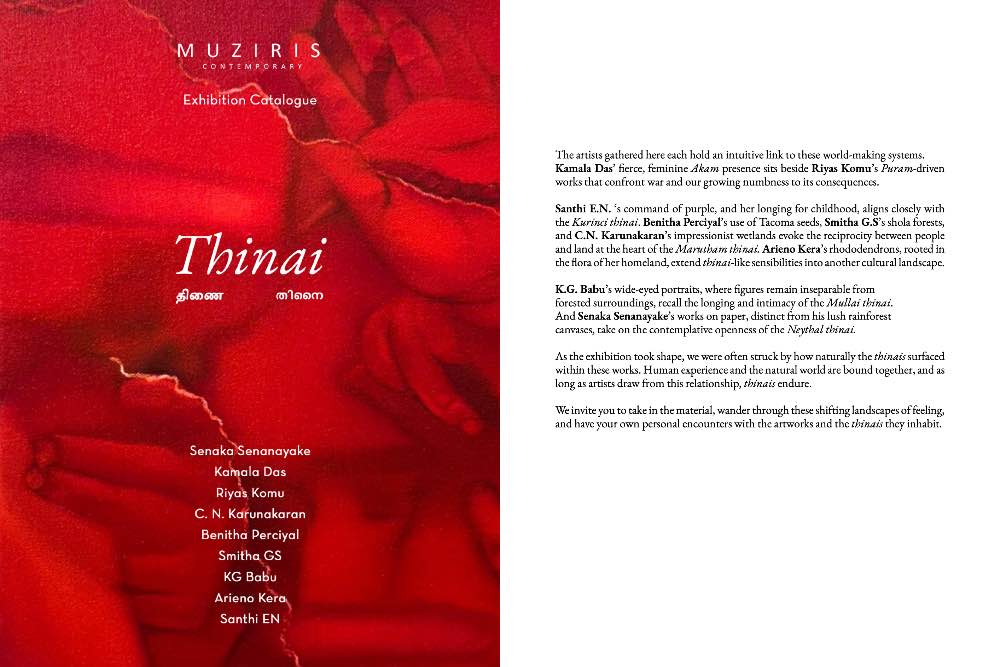
MUZIRIS CONTEMPORAY - THINAI
Thinais are world-making systems from the Sangam era, built on the idea that human feeling is inseparable from the environment. Literary critic S. Murali calls this “the earliest attempt at formulating an environmental aesthetic, where the human bhava (emOtion) seeks its correspondence in the natural vibhava (cause).”
Each thinai is named after local flora and is representative of the actual terrains of insular India, rooting its emotional worlds in the plants and ecologies that defined those regions.
According to the ancient Tamil treatise Tholkappiyam, poetic expression falls into two broad modes: Akam and Puram. Akam turns inward. It is intimate, feminine, anony- mous and centred on love in its many stages. Women shape much of its voice and tem- perament. Puram looks outward. It engages the masculine sphere, speaking of heroism, conflict, and public life. Its tone is largely shaped by men. Thinais are embedded within both Akam and Puram.
In the five Akam thinais, feelings unfold across landscape, time of day, colour, flora, and fauna, guided by a highly structured system of symbolism and metaphor that forms a complete cosmos. This sensorial logic finds strong resonance in the artistic traditions of the South, where narrative storytelling, masterful use of colour, and portraiture remain central. The exhibition reads this aesthetic lineage through the thinais, offering a unique context to the region's distinct visual languages
While Sangam poets grounded their verse in the terrains and living worlds of each thinai, they also allowed elements to travel between regions, recognising that nature resist- ed strict boundaries. Within this framework, nearly any artwork from the subcontinent could be seen through the lens of its ecological and emotional bearings.
MUZIRIS CONTEMPORARY >>
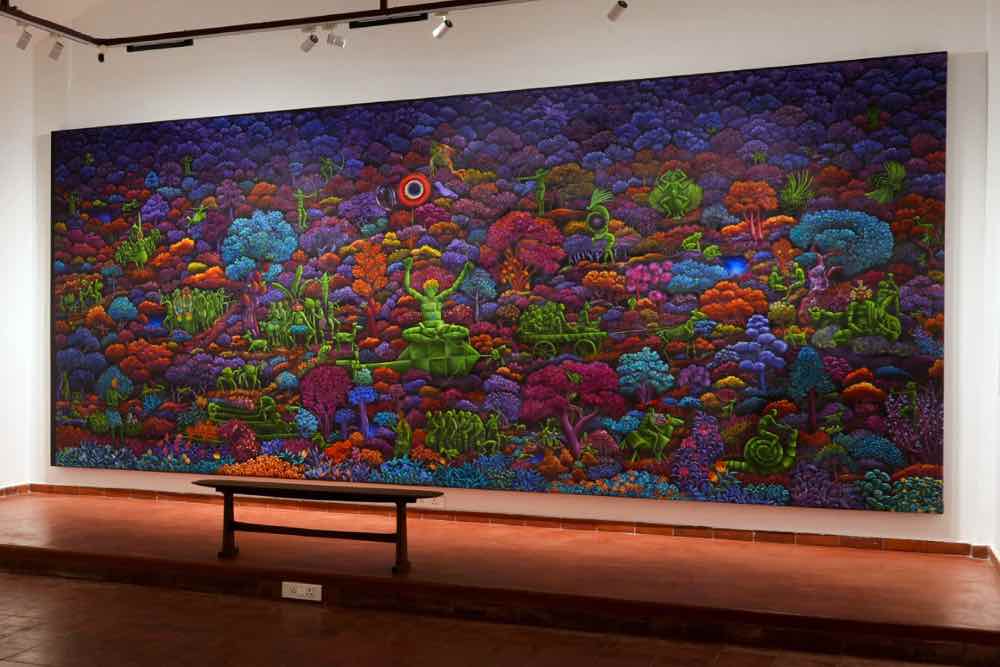
MUZIRIS CONTEMPORARY - THINAI - RIYAS KOMU
Riyas Komu (b. 1972 ) is one of India's most signif- icant contemporary artists, known for work that in- terrogates power, politics, and social structures. Born in Mattancherry, Kerala, he studied painting at the Sir J.J. School of Art in Mumbai and co-founded the Kochi-Muziris Biennale in 2012, transforming the cultural landscape of South Asia. Komu's practice spans painting, sculpture, and installation. His paintings are characterized by bold, confrontational imagery that challenges viewers to reckon with uncomfortable truths about authority, violence, and complicity. His sculptural works extend these concerns into three-dimensional space, using materials and forms that evoke both brutality and beauty. His work has been exhibited internationally at institutions includ- ing the Tate Modern, the Venice Biennale, and the Mori Art Museum, cementing his position as a crucial voice in contemporary art's engagement with pressing social and political questions.
MUZIRIS CONTEMPORARY >>
 ©
MUZIRIS CONTEMPORARY
©
MUZIRIS CONTEMPORARY
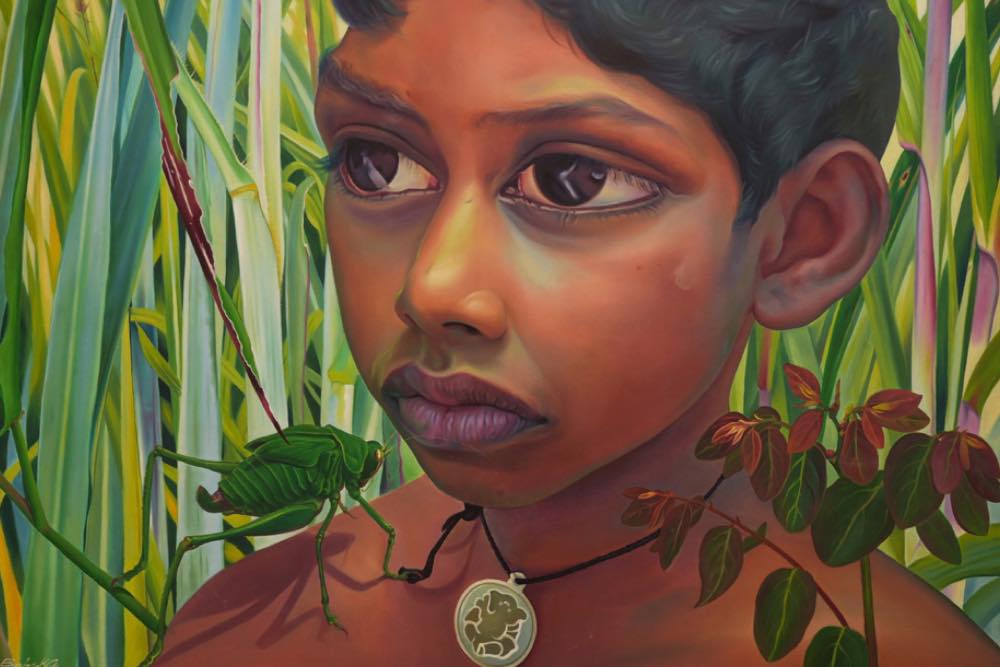
MUZIRIS CONTEMPORARY - THINAI - KG BABU
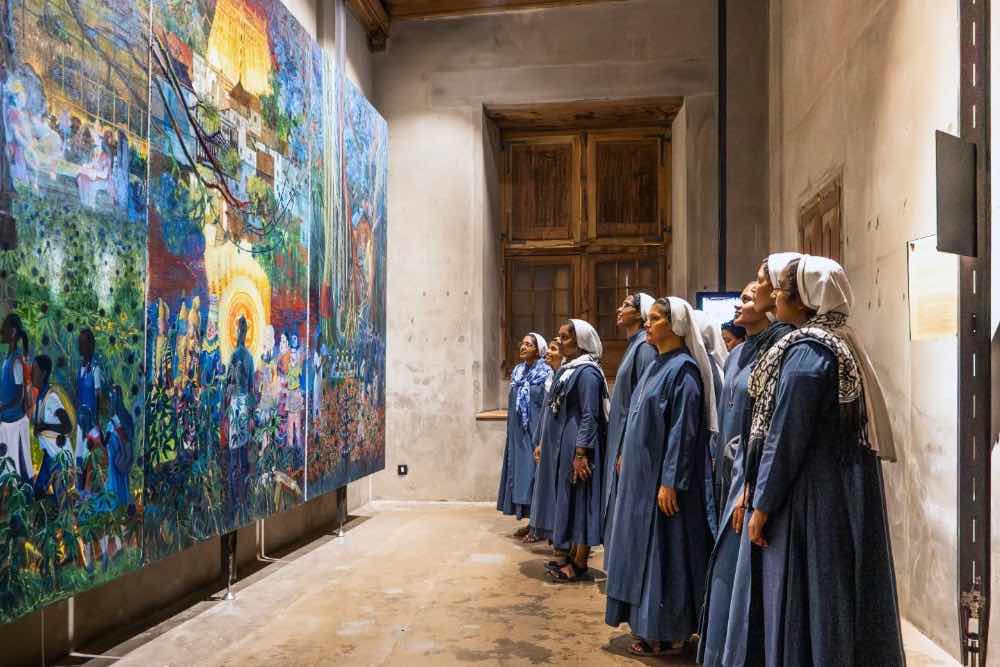
K.G. Babu (b. 1970) is a self-taught contemporary artist from Kerala whose vivid, surreal imagery explores the intimate bond between humanity and nature. Drawing on memories of forest life and tribal com- munities, his paintings and murals feature hyper-realistic human figures entangled with lush foliage, animals, and vibrant insects-most notably dragon-flies, which symbolize clarity and purity in his work. His large-scale oil and acrylic compositions evoke ecological interconnectedness and a melancholic nostalgia for the natural world.
Babu has developed a distinctive visual language that blurs the boundaries between human form and forest, suggesting an elemental unity often lost in modern life. Babu has exhibited internationally in Sweden, the USA, South Korea, China, and across India. His work continues to celebrate the inseparable unity of forest and soul, offering viewers a window into a world where nature and humanity are profoundly intertwined.
MUZIRIS CONTEMPORARY >>
 ©
MUZIRIS CONTEMPORARY
©
MUZIRIS CONTEMPORARY
MUZIRIS CONTEMPORARY - THINAI - SMITHA GS
Smitha G S, a self-taught artist from the Malabar region of Kozhikode in Kerala, is influenced by childhood memories brimming with nature's melodies. Her pieces emphasize animals and the intricate beauty of nature, often sidelining human forms. Yet, as her style evolved during the 2010s, Smitha's artworks began resonating with societal themes, such as Kerala's Nipah outbreak, juxtaposing human vulnerabilities with the unpredictable realm of animals. The Covid-19 lock- down marked a transformative phase, inspiring her to create a universe of happiness within the boundaries of her home. While her initial pieces celebrated the ani- mal world, her post-Covid creations started to weave in human figures, emphasizing the performing arts and rituals of Malabar, and their relation with nature.<br>Smitha's works were featured in the "Lokame Tharavadu" (The World is One Family) exhibition curated by Bose Krishnamachari in 2021, which was a break- through in her artistic career. Since then, numerous art institutions and galleries, both in India and abroad, have acknowledged and acquired her works.
MUZIRIS CONTEMPORARY >>
VAJIRA GUNAWARDENA
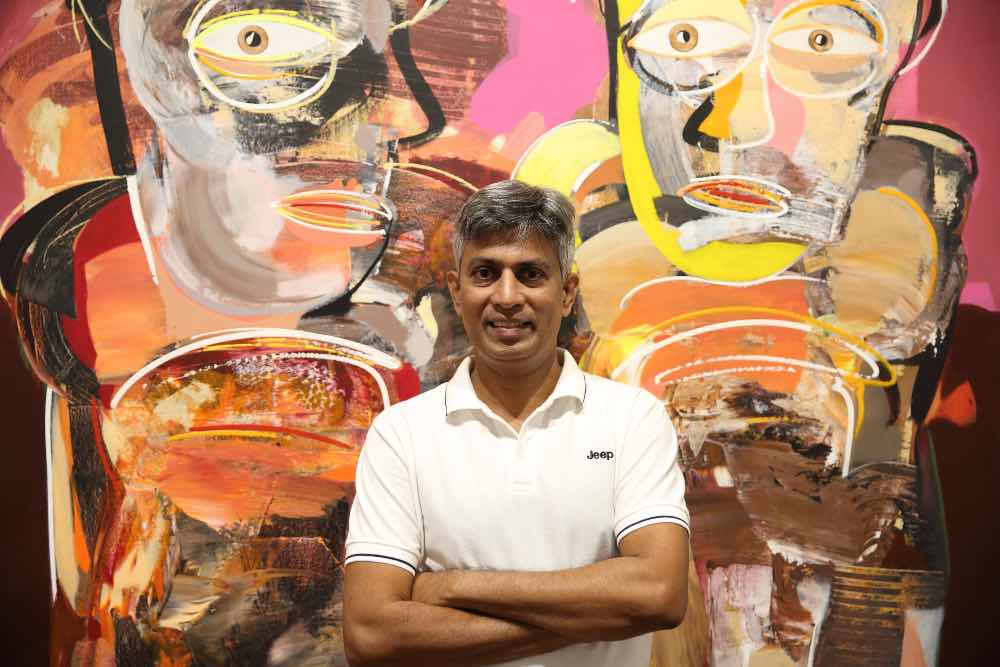
Vajira Gunawardena (born 1971) is a Sri Lankan award winner, one of the leading painters who have received a BFA degree at the state art school in Colombo. He is an internationally recognized artist selected for the international artist camps and symposiums and has also held numerous solo and group exhibitions locally and internationally. His works have many private and corporate collections worldwide in the UK, USA, Australia, Holland, Netherlands, France, Sweden, Belgium, Denmark, Italy, Dubai, Singapore, China, Malaysia, Thailand, Vietnam, Pakistan, Iran, Turkey, India, Maldives, And Sri Lanka. Vajira's paintings have a sociological mix of sensuous human emotions and autobiographical and critical qualities. The artist's artwork effectively merges elements of cubism and pop art with primitive figurative expression, capturing the dynamic essence of movement and the vivacious spirit of daily life.
KASHI ART CAFE AND GALLERY >>
FACEBOOK >>
INSTAGRAM >>




Founder & Director of Ayurveda Trails, healing collection of (extra)ordinary people and their stories, whose experiences are transferred into various trails shared by travelers.
SHILPI RAJAN: FIGURE, FIELD & FACT
Aazhi Archives and Uru Art Harbour are proud to present Shilpi Rajan, one of the living legends from Kerala, a self-taught artist hails from Thrissur, create his sculptures from natural materials in spirit of making shapes, enduring life and humour layered with tragic marks.

Theyyam is a vibrant and colourful form of ritualistic worship that is deeply rooted in the culture and traditions of Kerala, India. This living tradition involves elaborate rituals, music, dance, and vibrant costumes that bring to life the divine spirits being invoked.
What if precarity is the condition of our time or, to put it an other way, what if our time is ripe for sensing precarity? What if precarity, indeterminacy, and what we imagine as trivial are the center of the systematicity we seek?
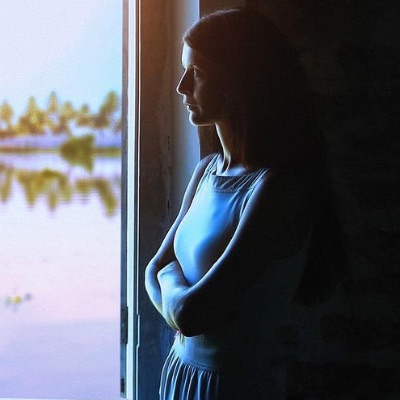
INDIA IN STYLE: 100 DAYS OF ART
India in Style, was created as part of Ayurveda Trails & Journals. During the Kochi-Muziris Biennale 2025-26, our founder Zuzana Zwiebel introduces one artist, event, or organisation every day, Here are the first 25 artworks. Let us inspire you!
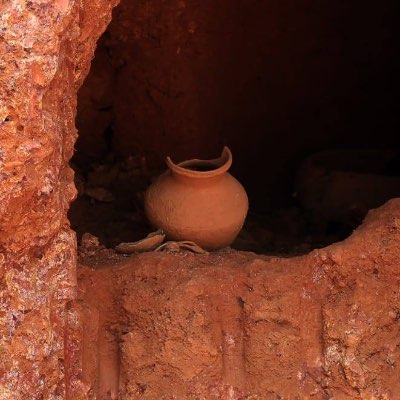
Can prehistoric artifacts be art? Come see for yourself at Kara in Fort Cochin! Mohamed A’s photographic images of excavations and the excavated - real, yet mysterious and enigmatic - take us on a journey into Kerala’s prehistoric past.

KOCHI-MUZIRIS BIENNALE 2025-26
The 6th edition of the KMB 2025 is curated by Nikhil Chopra with HH Art Spaces, an artist led organisation based in Goa. Chopra is a multidisciplinary artist whose practice interweaves performance, drawing, photography, sculpture, and installation.
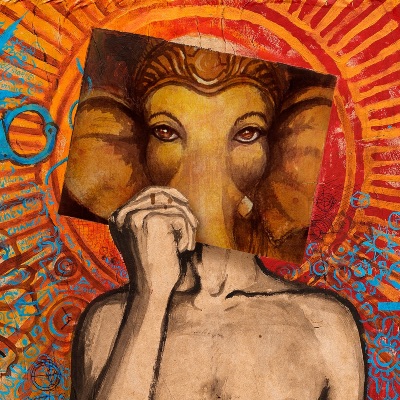
Ganesha is not for the artist a religious figure, it is a very personal almost incomprehensible connection, which has become a relationship that he commonly describes as being a mirror to the soul. Ganesha, in this case, is about portraying the image of a formless energy.

Chilean poet and featuring artist at the Kochi Muziris Biennale 2016 on the possibility of an artistic response to the human crises of our time, including the refugee crisis surrounding the conflict in Syria. The sea, which became a grave for hundreds of people, including children.
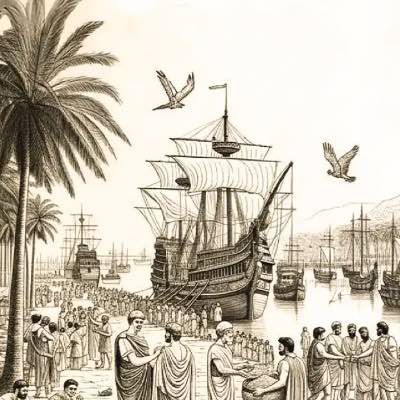
INTERNATIONAL SPICE ROUTE CONFERENCE 2026
Welcome to the First Edition of the Spice Routes Conference organized by the Muziris Heritage Project, Government of Kerala January 6-8, 2026 in Bolgatty Palace, Kochi. Step into a world where history, culture, and global connections converge.
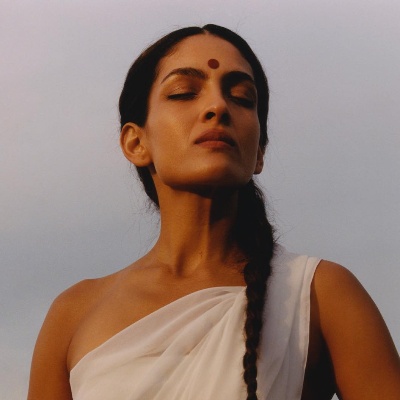
A new beginning is always infused with hope. Life is full of moments that we believe to be beginnings only because of the presence of hope. A physical symbol of these moments of hope is the flower. The films attempts to capture the emotion of these beginnings.
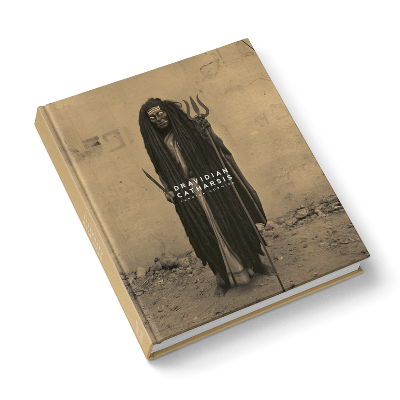
Dravidian Catharsis is the fruit of this deep immersion in the culture, the theatre, the traditions, and the soul of this mythological universe of the Tamil people. The powerful presences of spirits and living gods are embodied under masks.

Legend says that somewhere deep in the forest of the Himalayas is a strange bird that lays psychedelic eggs. Eating them will give you highly vivid hallucinations. The indigenous shamans believe that these visions are from your past life.
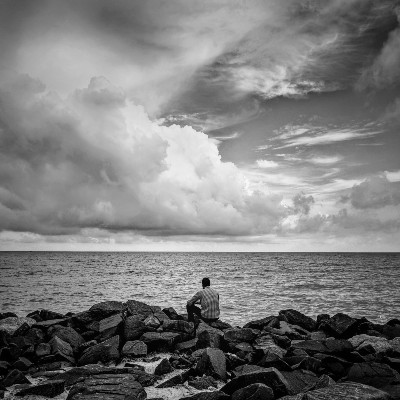
Ryuichi Sakamoto passed away this year on 28th March leaving behind a legacy of innumerable musical compositions that'll keep him alive in countless hearts across the world. However, I'll always be haunted by the fact that I couldn't let him know that I'm still alive because of his music along with many more.
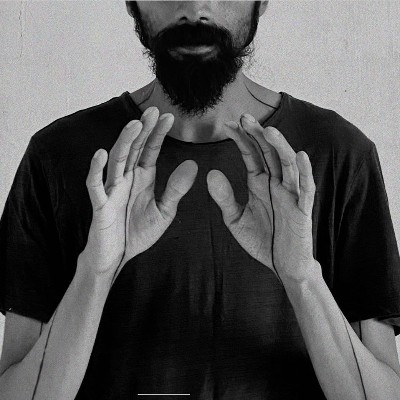
Search for the questions to the answers written on the skin...and i asked. am i connected to the deep inside you? with the invisible roots from the layered skin of you? all the energy you transfer to the heart of your thoughts?i asked again am i still connected?
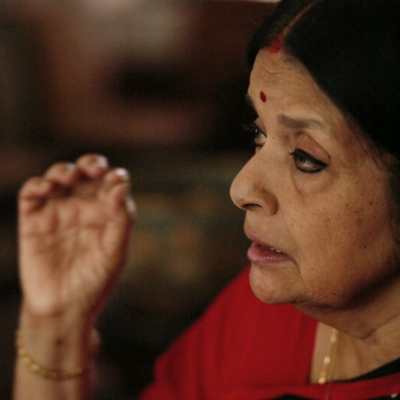
01: Ayurveda in Travancore Kingdom
If you expect stories which starts: Once upon a time, there was a princess... stop reading. Her Highness Princess Gouri Parvathi Bayi of the Travancore Royal Family will introduce us very modern and open minded view on today's Kerala society and ayurveda.

Stories of communities about origin, spread and apocalypse being presented through episodic memories, narrative and visual texts, travel writings, murals, divine objects, church paintings, and songs provide a dense and myriad repository of historical and artistic imagination.


